Assume that an exhaled breath of air consists of 74.8% N2, 15.3% O2, 3.7% CO2, and 6.2% water vapor. (b) If the volume of the exhaled gas is 455 mL and its temperature is 37 °C, calculate the number of moles of CO2 exhaled.
Ch.10 - Gases
10장, 문제 109
An ideal gas at a pressure of 152 kPa is contained in a bulb
of unknown volume. A stopcock is used to connect this
bulb with a previously evacuated bulb that has a volume
of 0.800 L as shown here. When the stopcock is opened,
the gas expands into the empty bulb. If the temperature
is held constant during this process and the final pressure
is 92.66 kPa, what is the volume of the bulb that was
originally filled with gas?

검증된 단계별 안내1
Convert the initial pressure from kPa to atm using the conversion factor: 1 atm = 101.325 kPa.
Use the combined gas law, which states that P1 * V1 = P2 * V2, where P1 and V1 are the initial pressure and volume, and P2 and V2 are the final pressure and volume.
Let V1 be the unknown volume of the initially filled bulb and V2 be the total volume after the stopcock is opened (V1 + 0.800 L).
Substitute the known values into the combined gas law equation: (P1 * V1) = (P2 * (V1 + 0.800 L)).
Solve for V1 by isolating it on one side of the equation.

비슷한 문제에 대한 검증된 영상 답변:
이 영상 해법은 위 문제에 도움이 된다고 튜터들이 추천한 것입니다.
영상 길이:
3m주요 개념
질문에 올바르게 답하기 위해 반드시 이해해야 하는 핵심 개념들은 다음과 같습니다.
Ideal Gas Law
The Ideal Gas Law is a fundamental equation in chemistry that relates the pressure (P), volume (V), temperature (T), and number of moles (n) of an ideal gas. It is expressed as PV = nRT, where R is the ideal gas constant. This law allows us to predict the behavior of gases under various conditions, making it essential for solving problems involving gas expansion and compression.
추천 영상:
가이드 코스
Ideal Gas Law Formula
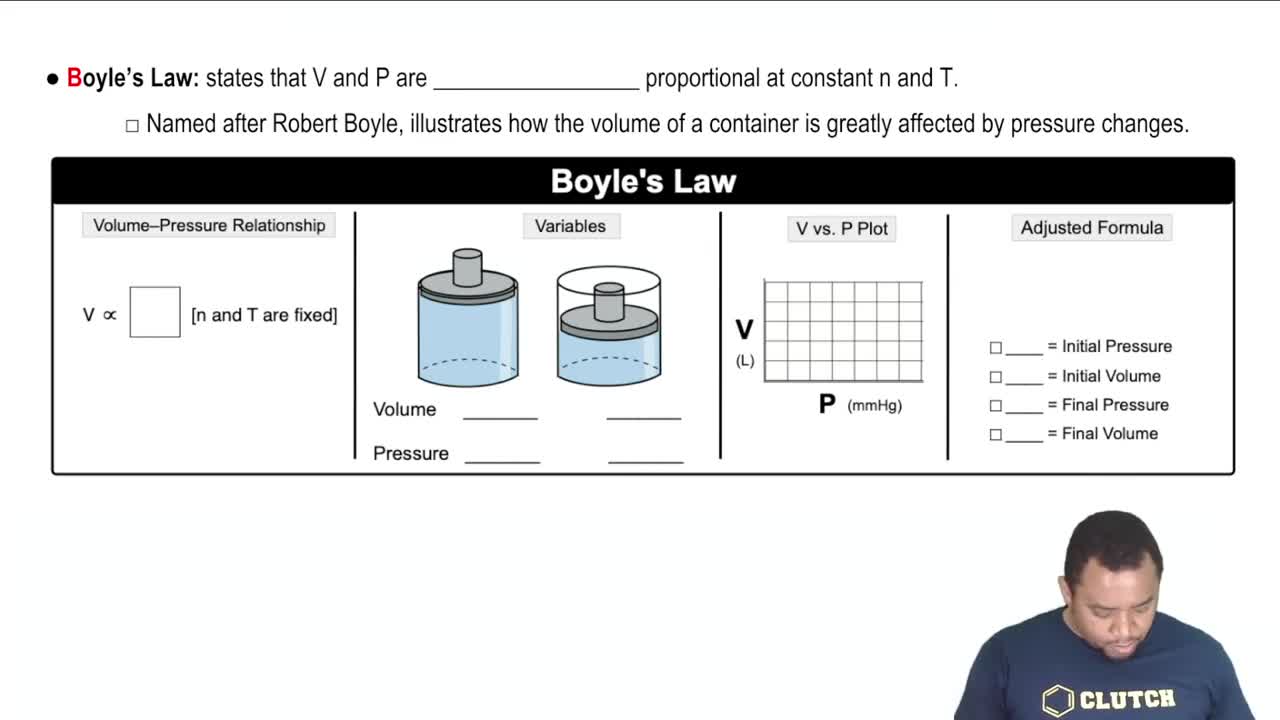
Boyle's Law
Boyle's Law states that the pressure of a gas is inversely proportional to its volume when the temperature and the amount of gas are held constant. Mathematically, it can be expressed as P1V1 = P2V2. This principle is crucial for understanding how gases behave when they expand or compress, particularly in scenarios like the one described in the question.
추천 영상:
가이드 코스
Boyle's Law
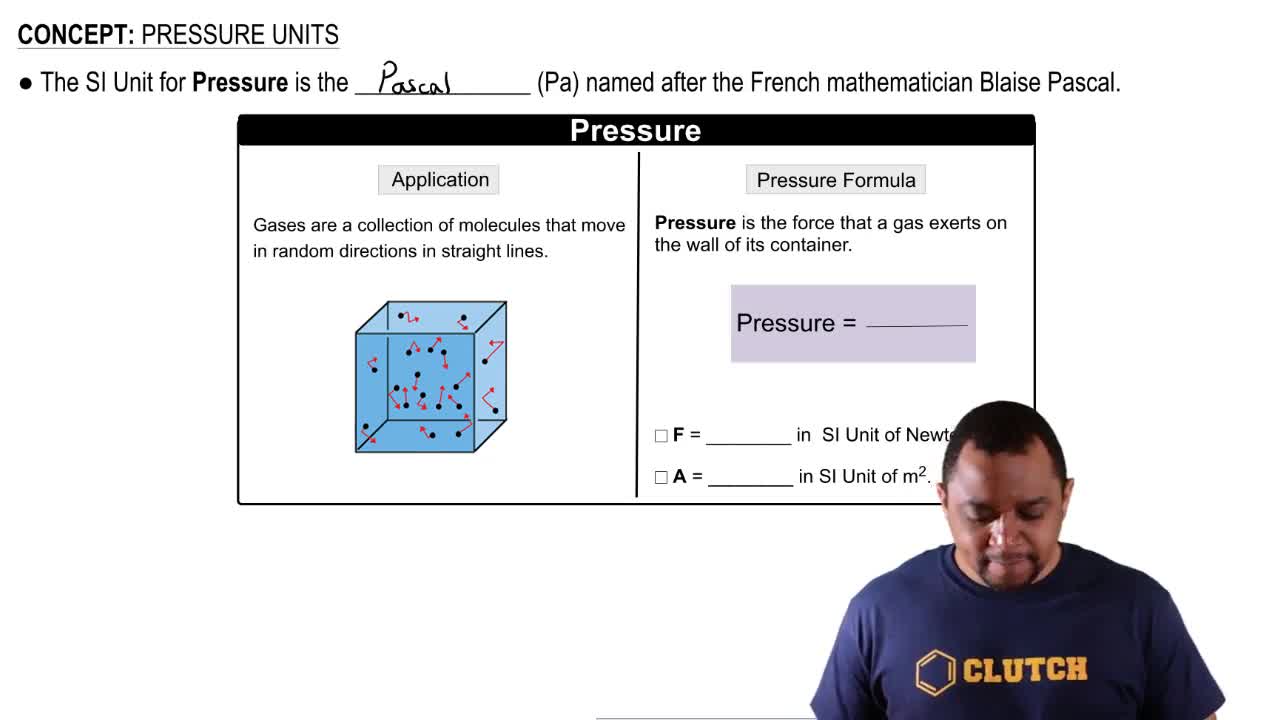
Pressure Units and Conversion
Pressure is commonly measured in various units, including atmospheres (atm), pascals (Pa), and kilopascals (kPa). Understanding how to convert between these units is vital for solving gas-related problems. In this question, the initial pressure is given in kPa, while the diagram shows pressure in atm, necessitating conversion for accurate calculations.
추천 영상:
가이드 코스
Pressure Units
관련 실천
교과서 질문
1
views
교과서 질문
Assume that an exhaled breath of air consists of 74.8% N2, 15.3% O2, 3.7% CO2, and 6.2% water vapor. (c) How many grams of glucose (C6H12O6) would need to be metabolized to produce this quantity of CO2? (The chemical reaction is the same as that for combustion of C6H12O6. See Section 3.2 and Problem 10.57.)
518
views
교과서 질문
The density of a gas of unknown molar mass was measured as a function of pressure at 0 C, as in the table that follows. (a) Determine a precise molar mass for the gas. [Hint: Graph d>P versus P.]
936
views
교과서 질문
The density of a gas of unknown molar mass was measured as a function of pressure at 0 C, as in the table that follows. (b) Why is d>P not a constant as a function of pressure?
619
views
교과서 질문
An 8.40-g sample of argon and an unknown mass of H2
are mixed in a flask at room temperature. The partial pressure
of the argon is 44.0 kPa, and that of the hydrogen is
57.33 kPa. What is the mass of the hydrogen?
608
views