
A sample of 3.00 g of SO2(g) originally in a 5.00-L vessel at 21 °C is transferred to a 10.0-L vessel at 26 °C. A sample of 2.35 g of N2(g) originally in a 2.50-L vessel at 20 °C is transferred to this same 10.0-L vessel. (c) What is the total pressure in the vessel?
Ch.10 - Gases
10장, 문제 72b
(b) What is the partial pressure in atm of each component of this mixture if its held in a 15.50-L vessel at 15 °C?
검증된 단계별 안내1
Step 1: Begin by identifying the components of the gas mixture. You will need the number of moles of each gas present in the mixture.
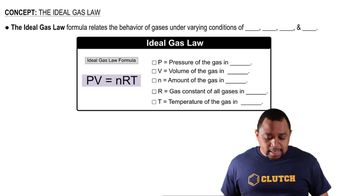
Step 2: Use the Ideal Gas Law, which is expressed as , where is the pressure, is the volume, is the number of moles, is the ideal gas constant, and is the temperature in Kelvin.
Step 3: Convert the temperature from Celsius to Kelvin using the formula . For 15 °C, calculate the temperature in Kelvin.
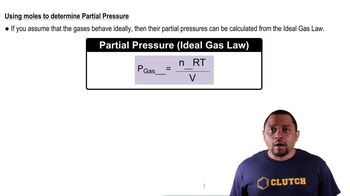
Step 4: Calculate the partial pressure of each gas using the Ideal Gas Law. Rearrange the formula to solve for pressure: . Substitute the values for each gas component.
Step 5: Ensure that the units are consistent, particularly for the ideal gas constant , which is typically L atm/mol K. Calculate the partial pressure for each component in atm.

비슷한 문제에 대한 검증된 영상 답변:
이 영상 해법은 위 문제에 도움이 된다고 튜터들이 추천한 것입니다.
영상 길이:
6m주요 개념
질문에 올바르게 답하기 위해 반드시 이해해야 하는 핵심 개념들은 다음과 같습니다.
Partial Pressure
Partial pressure is the pressure exerted by a single component of a gas mixture. According to Dalton's Law of Partial Pressures, the total pressure of a gas mixture is equal to the sum of the partial pressures of its individual components. This concept is crucial for calculating the contribution of each gas in a mixture to the overall pressure in a confined space.
추천 영상:
가이드 코스
Partial Pressure Calculation
Ideal Gas Law
The Ideal Gas Law relates the pressure, volume, temperature, and number of moles of a gas through the equation PV = nRT. This law is essential for determining the behavior of gases under various conditions. In this context, it can be used to calculate the partial pressures of each gas in the mixture when the total volume and temperature are known.
추천 영상:
가이드 코스
Ideal Gas Law Formula
Gas Mixtures
Gas mixtures consist of two or more gases that occupy the same volume and exert pressure independently. The behavior of each gas in a mixture can be analyzed separately, allowing for the application of the Ideal Gas Law to each component. Understanding how to treat gas mixtures is vital for accurately calculating the partial pressures of each gas in a given volume and temperature.
추천 영상:
가이드 코스
Solubility and Mixtures
관련 실천
교과서 질문
교과서 질문
(a) What are the mole fractions of H2 in a mixture of 15.08 g of O2, 8.17 g of N2, and 2.64 g of H2?
774
views
교과서 질문
A sample of 3.00 g of SO2(g) originally in a 5.00-L vessel at 21 °C is transferred to a 10.0-L vessel at 26 °C. A sample of 2.35 g of N2(g) originally in a 2.50-L vessel at 20 °C is transferred to this same 10.0-L vessel. (a) What is the partial pressure of SO2(g) in the larger container? (b) What is the partial pressure of N2(g) in this vessel?
491
views
교과서 질문
(a) What are the mole fractions of N2 in a mixture of 15.08 g of O2, 8.17 g of N2, and 2.64 g of H2?
884
views
교과서 질문
A quantity of N2 gas originally held at 531.96 kPa pressure
in a 1.00-L container at 26 °C is transferred to a 12.5-L container
at 20 °C. A quantity of O2 gas originally at 531.96 kPa
and 26 °C in a 5.00-L container is transferred to this same
container. What is the total pressure in the new container?
802
views
교과서 질문
(a) What are the mole fractions of O2 in a mixture of 15.08 g of O2, 8.17 g of N2, and 2.64 g of H2?
917
views
