
Calculate the pressure that CCl4 will exert at 80 °C if 1.00 mol occupies 33.3 L, assuming that (a) CCl4 obeys the ideal-gas equation (b) CCl4 obeys the van der Waals equation. (Values for the van der Waals constants are given in Table 10.3.)
Ch.10 - Gases
10장, 문제 94c
Calculate the pressure that CCl4 will exert at 80 °C if 1.00 mol occupies 33.3 L, assuming that (c) Which would you expect to deviate more from ideal behavior under these conditions, Cl2 or CCl4? Explain.
검증된 단계별 안내1
Step 1: Begin by identifying the ideal gas law equation, which is \( PV = nRT \). This equation relates the pressure \( P \), volume \( V \), number of moles \( n \), the ideal gas constant \( R \), and temperature \( T \).
Step 2: Convert the temperature from Celsius to Kelvin, as the ideal gas law requires temperature in Kelvin. Use the formula \( T(K) = T(°C) + 273.15 \). For 80 °C, calculate \( T(K) = 80 + 273.15 \).
Step 3: Substitute the known values into the ideal gas law equation. You have \( n = 1.00 \) mol, \( V = 33.3 \) L, \( R = 0.0821 \) L·atm/(mol·K), and the temperature in Kelvin from Step 2. Rearrange the equation to solve for pressure \( P \): \( P = \frac{nRT}{V} \).
Step 4: Consider the deviation from ideal behavior. Real gases deviate from ideal behavior due to intermolecular forces and the volume occupied by the gas particles themselves. Compare Cl2 and CCl4: CCl4 is a larger molecule with stronger intermolecular forces (London dispersion forces) compared to Cl2, which is smaller and has weaker forces.
Step 5: Conclude that CCl4 would deviate more from ideal behavior under these conditions due to its larger size and stronger intermolecular forces, which cause it to behave less ideally compared to Cl2.

비슷한 문제에 대한 검증된 영상 답변:
이 영상 해법은 위 문제에 도움이 된다고 튜터들이 추천한 것입니다.
영상 길이:
1m주요 개념
질문에 올바르게 답하기 위해 반드시 이해해야 하는 핵심 개념들은 다음과 같습니다.
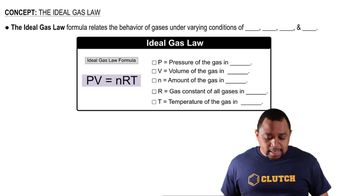
Ideal Gas Law
The Ideal Gas Law relates the pressure, volume, temperature, and number of moles of a gas through the equation PV = nRT. This law assumes that gas particles do not interact and occupy no volume, which is a simplification. Understanding this law is crucial for calculating the pressure exerted by gases under specific conditions.
추천 영상:
가이드 코스
Ideal Gas Law Formula
Real Gas Behavior
Real gases deviate from ideal behavior due to intermolecular forces and the volume occupied by gas particles. At high pressures and low temperatures, these deviations become significant. Recognizing the conditions under which gases behave ideally versus non-ideally helps in predicting which gas will deviate more from ideal behavior.
추천 영상:
가이드 코스
Ideal Gas Law Formula
Molecular Structure and Polarity
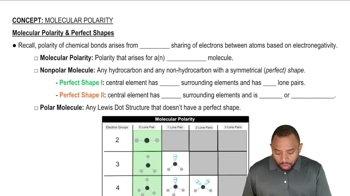
The molecular structure and polarity of a substance influence its intermolecular forces. CCl<sub>4</sub> is a nonpolar molecule, while Cl<sub>2</sub> is also nonpolar but has different molecular interactions. Understanding these properties helps in assessing how each gas will behave under varying conditions, particularly in terms of deviation from ideal gas behavior.
추천 영상:
가이드 코스
Molecular Polarity
관련 실천
교과서 질문
631
views
교과서 질문
A gas bubble with a volume of 1.0 mm3 originates at the bottom of a lake where the pressure is 3.0 atm. Calculate its volume when the bubble reaches the surface of the lake where the pressure is 730 torr, assuming that the temperature does not change.
691
views
교과서 질문
Table 10.3 shows that the van der Waals b parameter has units of L/mol. This means that we can calculate the sizes of atoms or molecules from the b parameter. Refer back to the discussion in Section 7.3. Is the van der Waals radius we calculate from the b parameter of Table 10.3 more closely associated with the bonding or nonbonding atomic radius discussed there? Explain.
1152
views
교과서 질문
Based on their respective van der Waals constants
( Table 10.3), is Ar or CO2 expected to behave more nearly
like an ideal gas at high pressures?
993
views
교과서 질문
Torricelli, who invented the barometer, used mercury in
its construction because mercury has a very high density,
which makes it possible to make a more compact barometer
than one based on a less dense fluid. Calculate the density
of mercury using the observation that the column of
mercury is 760 mm high when the atmospheric pressure is
1.01 * 105 Pa. Assume the tube containing the mercury is
a cylinder with a constant cross-sectional area.
816
views
