
Ch.10 - Gases
Brown - Chemistry: The Central Science 14th Edition
Brown14th EditionChemistry: The Central ScienceISBN: 9780134414232당신이 사용하는 게 아니라요?교과서 변경
10장, 문제 61a1

Consider the apparatus shown in the following drawing. (a) When the valve between the two containers is opened and the gases are allowed to mix, how does the volume occupied by the N2 gas change?
Diagram showing two gas containers with helium and argon, illustrating gas mixing in a chemistry experiment.

검증된 단계별 안내
1
Identify the initial conditions of the gases in each container: He (1.5 L, 1.0 atm, 26°C) and Ar (2.5 L, 1.5 atm, 26°C).
Recognize that when the valve is opened, the gases will mix and occupy the combined volume of both containers.
Calculate the total volume of the combined containers: V_total = V_He + V_Ar.
Understand that the volume occupied by each gas in the mixture will be the total volume of the combined containers.
Conclude that the volume occupied by the N2 gas (if it were present) would be the same as the total volume of the combined containers.

비슷한 문제에 대한 검증된 영상 답변:

이 영상 해법은 위 문제에 도움이 된다고 튜터들이 추천한 것입니다.
영상 길이:
1m

주요 개념

질문에 올바르게 답하기 위해 반드시 이해해야 하는 핵심 개념들은 다음과 같습니다.

Gas Laws

Gas laws describe the behavior of gases in relation to pressure, volume, and temperature. The ideal gas law (PV=nRT) is particularly relevant, as it relates these variables for an ideal gas. Understanding how gases expand to fill available volume is crucial when analyzing the mixing of gases in the apparatus.
추천 영상:
가이드 코스
01:43
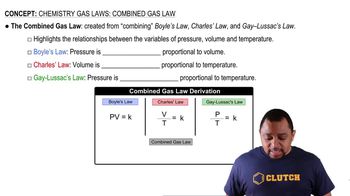
Combined Gas Law

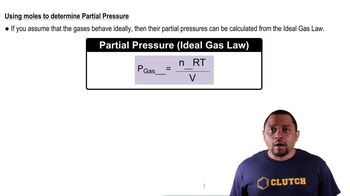
Partial Pressure

Partial pressure is the pressure exerted by a single gas in a mixture of gases. According to Dalton's Law, the total pressure of a gas mixture is the sum of the partial pressures of each individual gas. This concept is essential for understanding how the pressures of helium and argon will change when the gases mix.
추천 영상:
가이드 코스
00:48
Partial Pressure Calculation

Volume and Molar Relationships

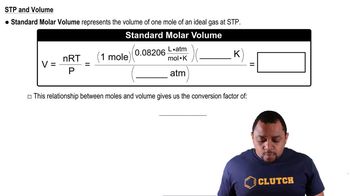
The volume occupied by a gas is directly related to the number of moles present and the conditions of temperature and pressure. When gases mix, they will occupy the total volume available, and the distribution of gas molecules will depend on their initial conditions. This relationship is key to predicting how the volume of nitrogen gas will change in the given scenario.
추천 영상:
가이드 코스
01:21
Standard Molar Volume
관련 실천
교과서 질문
Acetylene gas, C2H21g2, can be prepared by the reaction of calcium carbide with water: CaC21s2 + 2 H2O1l2¡Ca1OH221aq2 + C2H21g2 Calculate the volume of C2H2 that is collected over water at 23 °C by reaction of 1.524 g of CaC2 if the total pressure of the gas is 100.4 kPa. (The vapor pressure of water is tabulated in Appendix B.)
989
views
교과서 질문

Consider the apparatus shown in the following drawing. (a) When the valve between the two containers is opened and the gases are allowed to mix, what is the partial pressure of N2 after mixing?

1135
views
교과서 질문

Consider a mixture of two gases, A and B, confined in a closed vessel. A quantity of a third gas, C, is added to the same vessel at the same temperature. How does the addition of gas C affect the following: (a) the partial pressure of gas A?

835
views
교과서 질문
During a person's typical breathing cycle, the CO2 concentration in the expired air rises to a peak of 4.6% by volume. (a) Calculate the partial pressure of the CO2 in the expired air at its peak, assuming 1 atm pressure and a body temperature of 37 °C.
1363
views
교과서 질문

Both Jacques Charles and Joseph Louis Guy-Lussac were avid balloonists. In his original flight in 1783, Jacques Charles used a balloon that contained approximately 31,150 L of H2. He generated the H2 using the reaction between iron and hydrochloric acid: Fe1s2 + 2 HCl1aq2 ¡ FeCl21aq2 + H21g2 How many kilograms of iron were needed to produce this volume of H2 if the temperature was 22 °C?

845
views