Ch.10 - Gases
Brown - Chemistry: The Central Science 14th Edition
Brown14th EditionChemistry: The Central ScienceISBN: 9780134414232당신이 사용하는 게 아니라요?교과서 변경
10장, 문제 113a

Consider the following gases, all at STP: Ne, SF6, N2, CH4. (a) Which gas is most likely to depart from the assumption of the kinetic-molecular theory that says there are no attractive or repulsive forces between molecules?

검증된 단계별 안내
1
1. The kinetic-molecular theory assumes that there are no attractive or repulsive forces between molecules. This assumption is most likely to be violated by molecules that are polar or have a large number of electrons, as these characteristics can lead to intermolecular forces such as dipole-dipole interactions and London dispersion forces.
2. Ne is a noble gas and does not form molecules, so it has no intermolecular forces. N2 and CH4 are both nonpolar molecules, so they have only weak London dispersion forces.
3. SF6 is a large, complex molecule with many electrons, which means it has strong London dispersion forces. Additionally, although the molecule as a whole is nonpolar, the individual S-F bonds are polar, which could lead to some degree of dipole-induced dipole interactions.
4. Therefore, out of the given gases, SF6 is the most likely to depart from the assumption of the kinetic-molecular theory that there are no attractive or repulsive forces between molecules.

비슷한 문제에 대한 검증된 영상 답변:

이 영상 해법은 위 문제에 도움이 된다고 튜터들이 추천한 것입니다.
영상 길이:
5m

주요 개념

질문에 올바르게 답하기 위해 반드시 이해해야 하는 핵심 개념들은 다음과 같습니다.

Kinetic-Molecular Theory

The kinetic-molecular theory describes the behavior of gases in terms of particles in constant motion. It assumes that gas molecules are point particles with no volume and that they experience no intermolecular forces, allowing them to collide elastically. This theory helps explain gas properties such as pressure and temperature, but real gases can deviate from these ideal behaviors under certain conditions.
추천 영상:
가이드 코스
01:19
Kinetic Molecular Theory

Intermolecular Forces

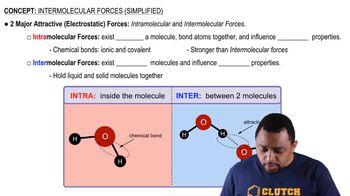
Intermolecular forces are the attractive or repulsive forces between molecules that can affect their physical properties. These forces include van der Waals forces, dipole-dipole interactions, and hydrogen bonding. Gases that exhibit significant intermolecular forces may not behave ideally, leading to deviations from the predictions of the kinetic-molecular theory, especially at high pressures or low temperatures.
추천 영상:
가이드 코스
01:59
Intermolecular vs Intramolecular Forces

Molecular Size and Complexity

The size and complexity of a molecule can influence its behavior as a gas. Larger and more complex molecules, such as SF6, tend to have stronger intermolecular forces due to their larger electron clouds and polarizability. In contrast, smaller and simpler molecules like Ne and N2 are more likely to behave ideally, as they have weaker intermolecular interactions, making them less likely to deviate from the assumptions of the kinetic-molecular theory.
추천 영상:
가이드 코스
00:43
Coordination Complexes Example