Ch.10 - Gases
Brown - Chemistry: The Central Science 14th Edition
Brown14th EditionChemistry: The Central ScienceISBN: 9780134414232당신이 사용하는 게 아니라요?교과서 변경
10장, 문제 113d

Consider the following gases, all at STP: Ne, SF6, N2, CH4. (d) Which one has the highest total molecular volume relative to the space occupied by the gas?

검증된 단계별 안내
1
Understand that at STP (Standard Temperature and Pressure), all gases occupy the same volume per mole, which is 22.4 L.
Recognize that the total molecular volume of a gas is related to the size of its molecules and the number of molecules present.
Consider that the molecular volume of a gas is negligible compared to the volume it occupies at STP, but larger molecules will have a slightly higher molecular volume.
Compare the molecular sizes: Ne (neon) is a noble gas with small atomic size, SF_6 (sulfur hexafluoride) is a large molecule due to its six fluorine atoms, N_2 (nitrogen) is a diatomic molecule, and CH_4 (methane) is a small tetrahedral molecule.
Conclude that SF_6, being the largest molecule among the given gases, will have the highest total molecular volume relative to the space occupied by the gas.

비슷한 문제에 대한 검증된 영상 답변:

이 영상 해법은 위 문제에 도움이 된다고 튜터들이 추천한 것입니다.
영상 길이:
1m

주요 개념

질문에 올바르게 답하기 위해 반드시 이해해야 하는 핵심 개념들은 다음과 같습니다.

Ideal Gas Law

The Ideal Gas Law (PV=nRT) describes the relationship between pressure (P), volume (V), temperature (T), and the number of moles (n) of a gas. At standard temperature and pressure (STP), gases behave ideally, allowing for the comparison of their volumes. Understanding this law is crucial for analyzing how different gases occupy space under the same conditions.
추천 영상:
가이드 코스
01:15
Ideal Gas Law Formula

Molar Volume of Gases

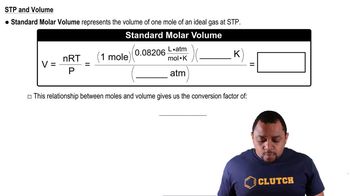
At STP, one mole of an ideal gas occupies a volume of 22.4 liters. This concept allows for the comparison of the volumes of different gases based on their molar masses and molecular structures. Gases with larger molar masses or more complex structures may occupy more space, influencing their total molecular volume.
추천 영상:
가이드 코스
01:21
Standard Molar Volume

Density of Gases

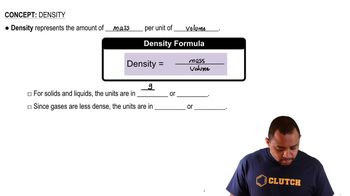
The density of a gas is defined as its mass per unit volume. It is influenced by the molecular weight and the conditions of temperature and pressure. In the context of the question, understanding the densities of Ne, SF6, N2, and CH4 helps determine which gas has the highest total molecular volume relative to the space it occupies, as denser gases will have more mass in the same volume.
추천 영상:
가이드 코스
01:56
Density Concepts