

Ch.10 - Gases
Brown - Chemistry: The Central Science 14th Edition
Brown14th EditionChemistry: The Central ScienceISBN: 9780134414232당신이 사용하는 게 아니라요?교과서 변경
10장, 문제 118a

Cyclopropane, a gas used with oxygen as a general anesthetic, is composed of 85.7% C and 14.3% H by mass. (a) If 1.56 g of cyclopropane has a volume of 1.00 L at 99.7 kPa and 50.0 °C, what is the molecular formula of cyclopropane?

검증된 단계별 안내
1
Calculate the molar mass of cyclopropane using the ideal gas law: PV = nRT. Convert the given pressure to atm and temperature to Kelvin, then solve for n (moles of gas).
Determine the empirical formula of cyclopropane. Assume 100 g of the compound, which gives 85.7 g of C and 14.3 g of H. Convert these masses to moles using the atomic masses of C and H.
Find the simplest whole number ratio of moles of C to H to determine the empirical formula.
Calculate the empirical formula mass and compare it to the molar mass obtained from the ideal gas law to find the ratio between the molecular and empirical formulas.
Multiply the subscripts in the empirical formula by this ratio to obtain the molecular formula of cyclopropane.

비슷한 문제에 대한 검증된 영상 답변:

이 영상 해법은 위 문제에 도움이 된다고 튜터들이 추천한 것입니다.
영상 길이:
13m

주요 개념

질문에 올바르게 답하기 위해 반드시 이해해야 하는 핵심 개념들은 다음과 같습니다.

Empirical and Molecular Formulas

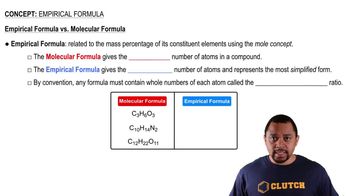
The empirical formula represents the simplest whole-number ratio of elements in a compound, while the molecular formula indicates the actual number of atoms of each element in a molecule. To determine the molecular formula, one often starts with the empirical formula and uses molar mass data to find the actual composition.
추천 영상:
가이드 코스
02:26
Empirical vs Molecular Formula

Ideal Gas Law

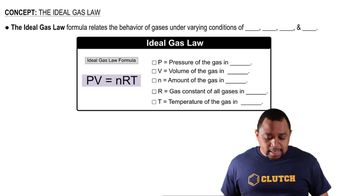
The Ideal Gas Law, expressed as PV = nRT, relates the pressure (P), volume (V), number of moles (n), gas constant (R), and temperature (T) of a gas. This law is essential for calculating the number of moles of cyclopropane in the given conditions, which is necessary for determining its molecular formula.
추천 영상:
가이드 코스
01:15
Ideal Gas Law Formula

Stoichiometry

Stoichiometry involves the calculation of reactants and products in chemical reactions based on the conservation of mass. In this context, it helps in determining the mass of carbon and hydrogen in cyclopropane from its percentage composition, which is crucial for deriving the empirical formula and subsequently the molecular formula.
추천 영상:
가이드 코스
01:16
Stoichiometry Concept
관련 실천
교과서 질문
It turns out that the van der Waals constant b equals four times the total volume actually occupied by the molecules of a mole of gas. Using this figure, calculate the fraction of the volume in a container actually occupied by Ar atoms (b) at 20.27 MPa pressure and 0 °C. (Assume for simplicity that the ideal-gas equation still holds.)
1405
views
교과서 질문

An herbicide is found to contain only C, H, N, and Cl. The complete combustion of a 100.0-mg sample of the herbicide in excess oxygen produces 83.16 mL of CO2 and 73.30 mL of H2O vapor expressed at STP. A separate analysis shows that the sample also contains 16.44 mg of Cl. (b) Calculate its empirical formula.

1707
views
교과서 질문

Cyclopropane, a gas used with oxygen as a general anesthetic, is composed of 85.7% C and 14.3% H by mass. (b) Judging from its molecular formula, would you expect cyclopropane to deviate more or less than Ar from ideal-gas behavior at moderately high pressures and room temperature? Explain.

교과서 질문

Large amounts of nitrogen gas are used in the manufacture of ammonia, principally for use in fertilizers. Suppose 120.00 kg of N2(g) is stored in a 1100.0-L metal cylinder at 280 °C. (c) Under the conditions of this problem, which correction dominates, the one for finite volume of gas molecules or the one for attractive interactions?

교과서 질문

Large amounts of nitrogen gas are used in the manufacture of ammonia, principally for use in fertilizers. Suppose 120.00 kg of N2(g) is stored in a 1100.0-L metal cylinder at 280 °C. (b) By using the data in Table 10.3, calculate the pressure of the gas according to the van der Waals equation.

932
views