
Ch.10 - Gases
Brown - Chemistry: The Central Science 14th Edition
Brown14th EditionChemistry: The Central ScienceISBN: 9780134414232당신이 사용하는 게 아니라요?교과서 변경
10장, 문제 125

Compare the enthalpy change upon combustion of a unit volume of liquid methane and liquid methanol. From the standpoint of energy production, which substance has the higher enthalpy of combustion per unit volume, given that methane, when liquefied, has a density of 0.466 g/mL, and the density of methanol at 25 °C is 0.791 g/mL?

검증된 단계별 안내
1
Identify the chemical formulas and balanced combustion reactions for both methane (CH₄) and methanol (CH₃OH).
Determine the molar mass of methane and methanol using their chemical formulas: CH₄ and CH₃OH.
Calculate the mass of methane and methanol in a given volume using their respective densities: 0.466 g/mL for methane and 0.791 g/mL for methanol.
Convert the mass of each substance to moles using their molar masses.
Use the standard enthalpy of combustion values for methane and methanol to calculate the enthalpy change per mole, then multiply by the number of moles to find the enthalpy change per unit volume for each substance.

주요 개념

질문에 올바르게 답하기 위해 반드시 이해해야 하는 핵심 개념들은 다음과 같습니다.

Enthalpy of Combustion

Enthalpy of combustion is the heat released when one mole of a substance is completely burned in oxygen. It is typically expressed in kilojoules per mole (kJ/mol) and is a crucial measure for evaluating the energy content of fuels. Higher enthalpy values indicate greater energy release, making it essential for comparing the energy production potential of different fuels.
추천 영상:
가이드 코스
02:24
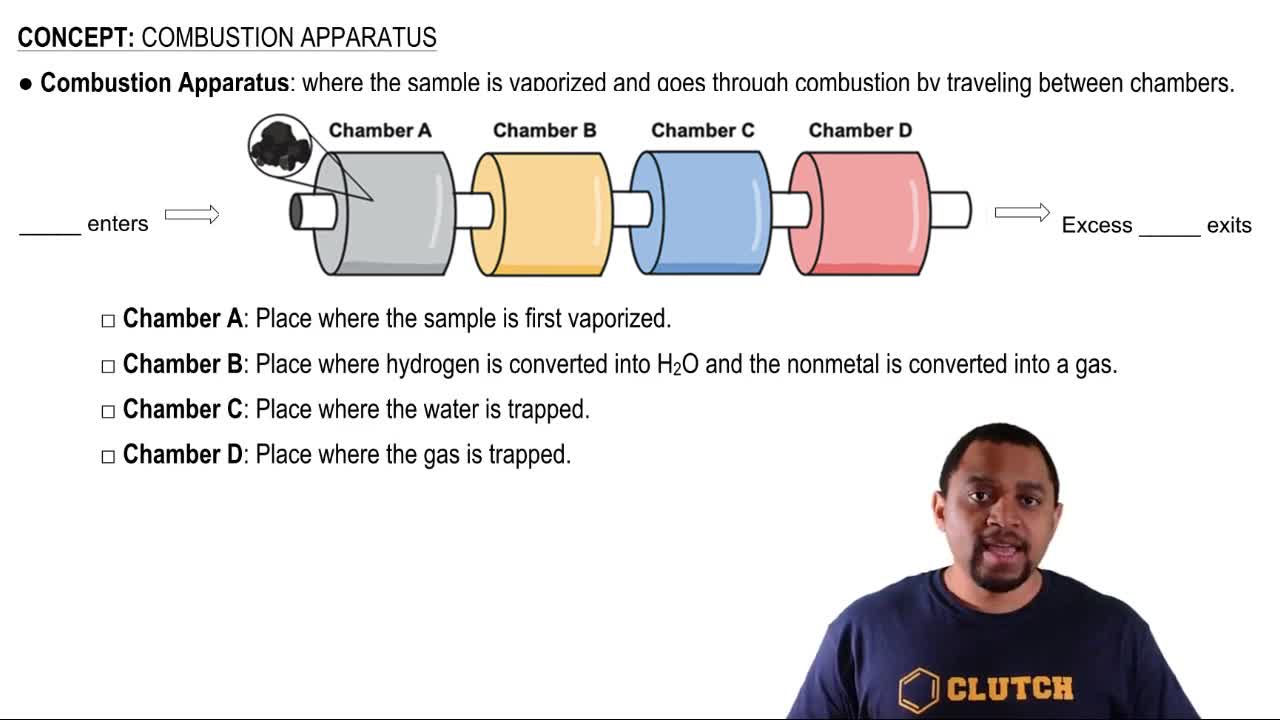
Combustion Apparatus

Density and Volume Relationships

Density is defined as mass per unit volume and is a critical factor in determining how much of a substance can fit into a given volume. In this context, the densities of liquid methane and methanol allow us to calculate their respective masses in a unit volume, which is necessary for comparing their enthalpy of combustion on a volumetric basis. Understanding these relationships helps in assessing which fuel provides more energy per unit volume.
추천 영상:
가이드 코스
01:09
Relationship of Volume and Moles Example

Comparative Energy Density

Comparative energy density refers to the amount of energy produced per unit volume of a fuel. This concept is vital when evaluating fuels for practical applications, as it helps determine which fuel is more efficient in terms of space and energy output. By calculating the enthalpy of combustion per unit volume for both methane and methanol, we can identify which substance is more advantageous for energy production.
추천 영상:
가이드 코스
01:56
Density Concepts
관련 실천
교과서 질문

Natural gas is very abundant in many Middle Eastern oil fields. However, the costs of shipping the gas to markets in other parts of the world are high because it is necessary to liquefy the gas, which is mainly methane and has a boiling point at atmospheric pressure of -164 °C. One possible strategy is to oxidize the methane to methanol, CH3OH, which has a boiling point of 65 °C and can therefore be shipped more readily. Suppose that 3.03×10⁸ m3 of methane at atmospheric pressure and 25 °C is oxidized to methanol. (a) What volume of methanol is formed if the density of CH3OH is 0.791 g/mL?

749
views
1
comments
교과서 질문

Ammonia and hydrogen chloride react to form solid ammonium chloride: NH3(g) + HCl(g) NH4Cl(s)

Two 2.00-L flasks at 25 °C are connected by a valve, as shown in the drawing. One flask contains 5.00 g of NH3(g), and the other contains 5.00 g of HCl(g). When the valve is opened, the gases react until one is completely consumed. (b) What will be the final pressure of the system after the reaction is complete? (Neglect the volume of the ammonium chloride formed.)

4501
views
교과서 질문

Gaseous iodine pentafluoride, IF5, can be prepared by the reaction of solid iodine and gaseous fluorine: I2(s) + 5 F2(g) → 2 IF5(g) A 5.00-L flask containing 10.0 g of I2 is charged with 10.0 g of F2, and the reaction proceeds until one of the reagents is completely consumed. After the reaction is complete, the temperature in the flask is 125 °C. (b) What is the mole fraction of IF5 in the flask?

교과서 질문

Gaseous iodine pentafluoride, IF5, can be prepared by the reaction of solid iodine and gaseous fluorine: I2(s) + 5 F2(g) → 2 IF5(g) A 5.00-L flask containing 10.0 g of I2 is charged with 10.0 g of F2, and the reaction proceeds until one of the reagents is completely consumed. After the reaction is complete, the temperature in the flask is 125 °C. (a) What is the partial pressure of IF5 in the flask?

982
views