Ch.10 - Gases
Brown - Chemistry: The Central Science 14th Edition
Brown14th EditionChemistry: The Central ScienceISBN: 9780134414232당신이 사용하는 게 아니라요?교과서 변경
10장, 문제 31

Suppose you are given two 2-L flasks and told that one contains a gas of molar mass 28, the other a gas of molar mass 56, both at the same temperature and pressure. The mass of gas in the flask A is 1.0 g and the mass of gas in the flask B is 2.0 g. Which flask contains the gas of molar mass 28, and which contains the gas of molar mass 56?

검증된 단계별 안내
1
Identify the relationship between mass, molar mass, and moles using the formula: \( n = \frac{m}{M} \), where \( n \) is the number of moles, \( m \) is the mass, and \( M \) is the molar mass.
Recognize that both gases are at the same temperature and pressure, and in the same volume, so they have the same number of moles according to Avogadro's law.
Calculate the number of moles for each flask using the given masses and molar masses: \( n_A = \frac{1.0 \text{ g}}{28 \text{ g/mol}} \) for flask A and \( n_B = \frac{2.0 \text{ g}}{56 \text{ g/mol}} \) for flask B.
Compare the calculated moles for each flask. Since the number of moles should be the same, the flask with the correct number of moles will match the molar mass.
Determine which flask corresponds to which molar mass based on the calculated moles, identifying flask A or B with the gas of molar mass 28 or 56.

비슷한 문제에 대한 검증된 영상 답변:

이 영상 해법은 위 문제에 도움이 된다고 튜터들이 추천한 것입니다.
영상 길이:
2m

주요 개념

질문에 올바르게 답하기 위해 반드시 이해해야 하는 핵심 개념들은 다음과 같습니다.

Ideal Gas Law

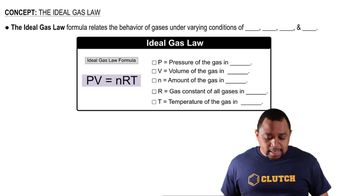
The Ideal Gas Law relates the pressure, volume, temperature, and number of moles of a gas through the equation PV = nRT. This law helps in understanding how gases behave under different conditions and is essential for determining the amount of gas present in a given volume at a specific temperature and pressure.
추천 영상:
가이드 코스
01:15
Ideal Gas Law Formula

Molar Mass and Density

Molar mass is the mass of one mole of a substance, typically expressed in grams per mole (g/mol). The density of a gas can be calculated using its molar mass and the Ideal Gas Law, allowing us to relate the mass of gas in a flask to its volume and molar mass, which is crucial for solving the problem.
추천 영상:
가이드 코스
02:11
Molar Mass Concept

Mass and Moles Relationship

The relationship between mass, moles, and molar mass is given by the equation: mass = moles × molar mass. This concept is vital for determining how many moles of gas are present in each flask based on the given mass, enabling us to identify which gas corresponds to each molar mass.
추천 영상:
가이드 코스
02:28
Mass and Moles Conversion