(a) Calculate the density of NO2 gas at 0.970 atm and 35 °C.
Ch.10 - Gases
10장, 문제 49
Which of the following statements best explains why a closed balloon filled with helium gas rises in air? (a) Helium is a monatomic gas, whereas nearly all the molecules that make up air, such as nitrogen and oxygen, are diatomic. (b) The average speed of helium atoms is greater than the average speed of air molecules, and the greater speed of collisions with the balloon walls propels the balloon upward. (c) Because the helium atoms are of lower mass than the average air molecule, the helium gas is less dense than air. The mass of the balloon is thus less than the mass of the air displaced by its volume. (d) Because helium has a lower molar mass than the average air molecule, the helium atoms are in faster motion. This means that the temperature of the helium is greater than the air temperature. Hot gases tend to rise.
검증된 단계별 안내1
First, let's understand the principle of buoyancy. According to Archimedes' principle, an object immersed in a fluid experiences a buoyant force equal to the weight of the fluid displaced by the object. If the weight of the object is less than the weight of the fluid it displaces, the object will float or rise in the fluid.
Option (a) states that helium is a monatomic gas, whereas nearly all the molecules that make up air, such as nitrogen and oxygen, are diatomic. While this is true, it doesn't explain why helium rises in air.
Option (b) suggests that the average speed of helium atoms is greater than the average speed of air molecules, and the greater speed of collisions with the balloon walls propels the balloon upward. This is not the reason why helium balloons rise. The speed of gas molecules does not directly affect the buoyancy of an object.
Option (c) states that because the helium atoms are of lower mass than the average air molecule, the helium gas is less dense than air. The mass of the balloon is thus less than the mass of the air displaced by its volume. This statement is correct and aligns with the principle of buoyancy. The helium-filled balloon is less dense than the air it displaces, so it rises.
Option (d) suggests that because helium has a lower molar mass than the average air molecule, the helium atoms are in faster motion. This means that the temperature of the helium is greater than the air temperature. Hot gases tend to rise. While it's true that hot gases rise, this is not the primary reason why a helium balloon rises. The temperature of the helium in the balloon is not necessarily higher than the surrounding air temperature.

비슷한 문제에 대한 검증된 영상 답변:
이 영상 해법은 위 문제에 도움이 된다고 튜터들이 추천한 것입니다.
영상 길이:
1m주요 개념
질문에 올바르게 답하기 위해 반드시 이해해야 하는 핵심 개념들은 다음과 같습니다.
Density and Buoyancy
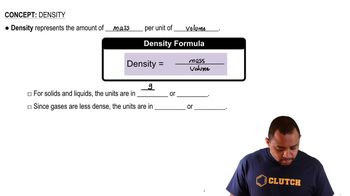
Density is defined as mass per unit volume. An object will float or rise in a fluid if it is less dense than the fluid. In this context, helium is less dense than the surrounding air, which allows the balloon to rise due to buoyant forces acting on it.
추천 영상:
가이드 코스
Density Concepts
Kinetic Molecular Theory
The Kinetic Molecular Theory explains the behavior of gases in terms of particles in constant motion. It states that lighter gas particles, like helium, move faster than heavier particles, such as those in air. This increased speed contributes to the buoyancy of helium-filled balloons.
추천 영상:
가이드 코스
Kinetic Molecular Theory
Archimedes' Principle
Archimedes' Principle states that an object submerged in a fluid experiences an upward buoyant force equal to the weight of the fluid it displaces. For the balloon, the weight of the air displaced is greater than the weight of the helium and the balloon, resulting in an upward force that causes it to rise.
추천 영상:
가이드 코스
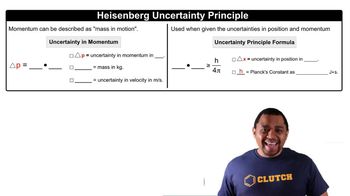
Uncertainty Principle Formula
관련 실천
교과서 질문
559
views
교과서 질문
Rank the following gases and vapors from least dense
to most dense at 101.33 kPa and 298 K: water vapor
1H2O1g22, nitrogen 1N22, hydrogen sulfide 1H2S2.
822
views
교과서 질문
The physical fitness of athletes is measured by 'VO2 max,' which is the maximum volume of oxygen consumed by an individual during incremental exercise (for example, on a treadmill). An average male has a VO2 max of 45 mL O2/kg body mass/min, but a world-class male athlete can have a VO2 max reading of 88.0 mL O2/kg body mass/min. (a) Calculate the volume of oxygen, in mL, consumed in 1 hr by an average man who weighs 85 kg and has a VO2 max reading of 47.5 mL O2/kg body mass/min. (b) If this man lost 10 kg, exercised, and increased his VO2 max to 65.0 mL O2/kg body mass/min, how many mL of oxygen would he consume in 1 hr?
981
views
교과서 질문
(b) Calculate the molar mass of a vapor that
has a density of 7.135 g>L at 12 °C and 99.06 kPa.
1066
views
교과서 질문
Rank the following gases from least dense to most dense at
101.33 kPa and 298 K: O2, Ar, NH3, HCl.
870
views
교과서 질문
(b) Calculate the molar mass of a gas if 2.50 g occupies 0.875 L at 685 torr and 35 °C
977
views