Ch.10 - Gases
Brown - Chemistry: The Central Science 14th Edition
Brown14th EditionChemistry: The Central ScienceISBN: 9780134414232당신이 사용하는 게 아니라요?교과서 변경
10장, 문제 78

You have an evacuated container of fixed volume and known mass and introduce a known mass of a gas sample. Measuring the pressure at constant temperature over time, you are surprised to see it slowly dropping. You measure the mass of the gas-filled container and find that the mass is what it should be—gas plus container—and the mass does not change over time, so you do not have a leak. Suggest an explanation for your observations.

검증된 단계별 안내
1
Consider the possibility of gas adsorption onto the container walls, which would reduce the number of gas molecules in the gas phase, leading to a decrease in pressure.
Think about the potential for a chemical reaction occurring within the container that consumes gas molecules, thus reducing the pressure.
Evaluate whether the gas could be undergoing a phase change, such as condensation, which would decrease the pressure as gas molecules transition to a liquid phase.
Examine the temperature stability to ensure that there are no fluctuations causing changes in gas behavior, even though the problem states constant temperature.
Reflect on the accuracy and calibration of the pressure measurement device to rule out any instrumental errors that might falsely indicate a pressure drop.

비슷한 문제에 대한 검증된 영상 답변:

이 영상 해법은 위 문제에 도움이 된다고 튜터들이 추천한 것입니다.
영상 길이:
2m
도움이 되었나요?

주요 개념

질문에 올바르게 답하기 위해 반드시 이해해야 하는 핵심 개념들은 다음과 같습니다.

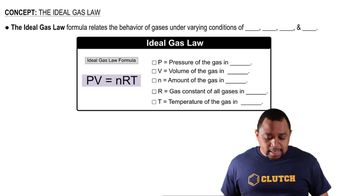
Ideal Gas Law

The Ideal Gas Law relates the pressure, volume, temperature, and number of moles of a gas through the equation PV = nRT. In this scenario, the pressure drop at constant temperature suggests that the number of gas molecules (n) may be decreasing, which could indicate a change in the gas's state or behavior, rather than a leak.
추천 영상:
가이드 코스
01:15
Ideal Gas Law Formula

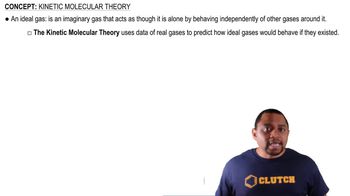
Gas Behavior and Kinetic Molecular Theory

Kinetic Molecular Theory explains how gas particles behave, emphasizing that gas pressure results from collisions of particles with the container walls. If the pressure is dropping while the mass remains constant, it may imply that the gas is undergoing a phase change or chemical reaction that alters its effective pressure without losing mass.
추천 영상:
가이드 코스
01:19
Kinetic Molecular Theory

Real Gases vs. Ideal Gases

Real gases deviate from ideal behavior under certain conditions, such as high pressure or low temperature. If the gas sample behaves non-ideally, interactions between gas molecules could lead to a decrease in pressure over time, even if the mass remains unchanged, due to factors like condensation or adsorption onto the container walls.
추천 영상:
가이드 코스
02:27
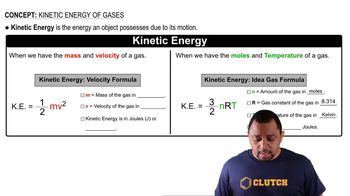
Kinetic Energy Formulas
관련 실천
교과서 질문

Suppose you have two 1-L flasks, one containing N2 at STP, the other containing CH4 at STP. How do these systems compare with respect to (a) number of molecules?

453
views

교과서 질문

The temperature of a 5.00-L container of N2 gas is increased from 20 °C to 250 °C. If the volume is held constant, predict qualitatively how this change affects the following: (a) the average kinetic energy of the molecules.

758
views
교과서 질문

Indicate which of the following statements regarding the kinetic-molecular theory of gases are correct. (a) The average kinetic energy of a collection of gas molecules at a given temperature is proportional to m1/2. (b) The gas molecules are assumed to exert no forces on each other. (c) All the molecules of a gas at a given temperature have the same kinetic energy. (d) The volume of the gas molecules is negligible in comparison to the total volume in which the gas is contained. (e) All gas molecules move with the same speed if they are at the same temperature.

979
views
교과서 질문
Radon (Rn) is the heaviest (and only radioactive) member of the noble gases. How much slower is the root-mean-square speed of Rn than He at 300 K?
1690
views
교과서 질문

Determine whether each of the following changes will increase, decrease, or not affect the rate with which gas molecules collide with the walls of their container: (a) increasing the volume of the container (b) increasing the temperature (c) increasing the molar mass of the gas

1076
views
교과서 질문

The temperature of a 5.00-L container of N2 gas is increased from 20 °C to 250 °C. If the volume is held constant, predict qualitatively how this change affects the following: (b) the rootmean-square speed of the molecules. (c) the strength of the impact of an average molecule with the container walls. (d) the total number of collisions of molecules with walls per second.

756
views