Ch.11 - Liquids and Intermolecular Forces
Brown - Chemistry: The Central Science 14th Edition
Brown14th EditionChemistry: The Central ScienceISBN: 9780134414232당신이 사용하는 게 아니라요?교과서 변경
11장, 문제 51

(a) Place the following substances in order of increasing volatility: CH4, CBr4, CH2Cl2, CH3Cl, CHBr3, and CH2Br2. (b) How do the boiling points vary through this series? (c) Explain your answer to part (b) in terms of intermolecular forces.

검증된 단계별 안내
1
Identify the types of intermolecular forces present in each substance: CH_4, CBr_4, CH_2Cl_2, CH_3Cl, CHBr_3, and CH_2Br_2. Consider London dispersion forces, dipole-dipole interactions, and hydrogen bonding.
Recognize that volatility is inversely related to the strength of intermolecular forces. Substances with weaker intermolecular forces are more volatile.
Arrange the substances in order of increasing volatility by comparing the strength of their intermolecular forces. Consider molecular weight and polarity.
For boiling points, note that they are directly related to the strength of intermolecular forces. Substances with stronger intermolecular forces have higher boiling points.
Explain the variation in boiling points by discussing the role of molecular weight and polarity in determining the strength of London dispersion forces and dipole-dipole interactions.

비슷한 문제에 대한 검증된 영상 답변:

이 영상 해법은 위 문제에 도움이 된다고 튜터들이 추천한 것입니다.
영상 길이:
2m
도움이 되었나요?

주요 개념

질문에 올바르게 답하기 위해 반드시 이해해야 하는 핵심 개념들은 다음과 같습니다.

Volatility

Volatility refers to the tendency of a substance to vaporize. It is influenced by the strength of intermolecular forces; substances with weaker forces tend to be more volatile. For example, lighter molecules with weaker London dispersion forces will evaporate more readily than heavier molecules with stronger dipole-dipole interactions or hydrogen bonds.
추천 영상:
가이드 코스
02:50
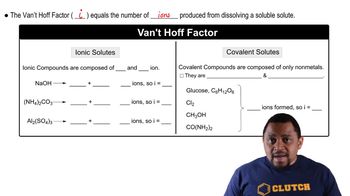
Van't Hoff Factor

Boiling Point

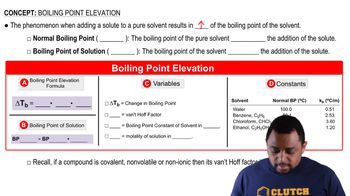
The boiling point of a substance is the temperature at which its vapor pressure equals the external pressure, allowing it to transition from liquid to gas. Generally, higher boiling points indicate stronger intermolecular forces. In the context of the given substances, as molecular weight and polarity increase, boiling points typically rise due to enhanced van der Waals forces.
추천 영상:
가이드 코스
03:05
Boiling Point Elevation

Intermolecular Forces

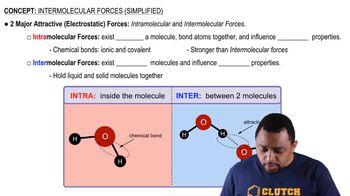
Intermolecular forces are the forces of attraction or repulsion between molecules. They include London dispersion forces, dipole-dipole interactions, and hydrogen bonds. The type and strength of these forces significantly affect both volatility and boiling points; for instance, substances with stronger intermolecular forces will have lower volatility and higher boiling points compared to those with weaker forces.
추천 영상:
가이드 코스
01:59
Intermolecular vs Intramolecular Forces