
Ch.11 - Liquids and Intermolecular Forces
Brown - Chemistry: The Central Science 14th Edition
Brown14th EditionChemistry: The Central ScienceISBN: 9780134414232당신이 사용하는 게 아니라요?교과서 변경
11장, 문제 2

(a) Which kind of intermolecular attractive force is shown in each case here? (b) Predict which of the four interactions is the weakest. [Section 11.2]

검증된 단계별 안내
1
Identify the types of intermolecular forces: London dispersion forces, dipole-dipole interactions, hydrogen bonding, and ion-dipole interactions.
Determine the molecular characteristics of each case to identify the type of intermolecular force present.
For each case, check if the molecules are nonpolar (London dispersion), polar (dipole-dipole), have hydrogen bonded to N, O, or F (hydrogen bonding), or involve ions (ion-dipole).
Compare the strength of the identified intermolecular forces: London dispersion forces are generally the weakest, followed by dipole-dipole interactions, hydrogen bonding, and ion-dipole interactions.
Predict which interaction is the weakest based on the identified intermolecular forces in each case.

비슷한 문제에 대한 검증된 영상 답변:

이 영상 해법은 위 문제에 도움이 된다고 튜터들이 추천한 것입니다.
영상 길이:
1m
도움이 되었나요?

주요 개념

질문에 올바르게 답하기 위해 반드시 이해해야 하는 핵심 개념들은 다음과 같습니다.

Intermolecular Forces

Intermolecular forces are the attractive forces between molecules that influence physical properties such as boiling and melting points. The main types include hydrogen bonding, dipole-dipole interactions, and London dispersion forces. Understanding these forces is crucial for predicting how substances will behave in different states and conditions.
추천 영상:
가이드 코스
01:59
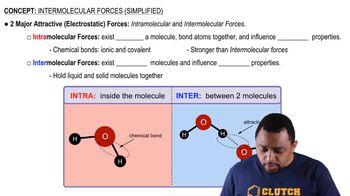
Intermolecular vs Intramolecular Forces

Hydrogen Bonding

Hydrogen bonding is a specific type of strong dipole-dipole interaction that occurs when hydrogen is covalently bonded to highly electronegative atoms like nitrogen, oxygen, or fluorine. This interaction significantly affects the properties of substances, such as water's high boiling point compared to other similar-sized molecules, making it essential for understanding molecular behavior.
추천 영상:
가이드 코스
01:22
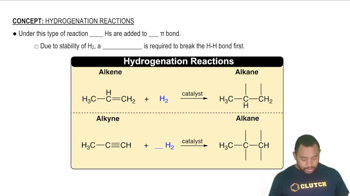
Hydrogenation Reactions

Strength of Intermolecular Forces

The strength of intermolecular forces varies among the different types, with hydrogen bonds being the strongest, followed by dipole-dipole interactions, and then London dispersion forces, which are the weakest. Recognizing this hierarchy is important for predicting the physical properties of substances, such as solubility and volatility.
추천 영상:
가이드 코스
01:59
Intermolecular vs Intramolecular Forces