Ch.11 - Liquids and Intermolecular Forces
Brown - Chemistry: The Central Science 14th Edition
Brown14th EditionChemistry: The Central ScienceISBN: 9780134414232당신이 사용하는 게 아니라요?교과서 변경
11장, 문제 14b

Benzoic acid, C6H5COOH, melts at 122 °C. The density in the liquid state at 130 °C is 1.08 g/cm3. The density of solid benzoic acid at 15 °C is 1.266 g/cm3. (b) If you converted a cubic centimeter of liquid benzoic acid into a solid, would the solid take up more, or less, volume than the original cubic centimeter of liquid?

검증된 단계별 안내
1
Step 1: Understand the problem. The problem is asking whether the volume of solid benzoic acid is more or less than the volume of liquid benzoic acid, given the densities of both states.
Step 2: Recall the formula for density, which is mass divided by volume (Density = Mass/Volume). This means that the volume of a substance can be calculated by dividing its mass by its density.
Step 3: Since the mass of the benzoic acid doesn't change when it changes state, we can say that the mass of the liquid benzoic acid is equal to the mass of the solid benzoic acid.
Step 4: Use the densities given in the problem to calculate the volume of the benzoic acid in both states. For the liquid state, the volume is the mass divided by the density of the liquid (1.08 g/cm3). For the solid state, the volume is the mass divided by the density of the solid (1.266 g/cm3).
Step 5: Compare the volumes calculated in step 4. If the volume of the solid is greater than the volume of the liquid, then the solid takes up more space. If the volume of the solid is less than the volume of the liquid, then the solid takes up less space.

비슷한 문제에 대한 검증된 영상 답변:

이 영상 해법은 위 문제에 도움이 된다고 튜터들이 추천한 것입니다.
영상 길이:
1m

주요 개념

질문에 올바르게 답하기 위해 반드시 이해해야 하는 핵심 개념들은 다음과 같습니다.

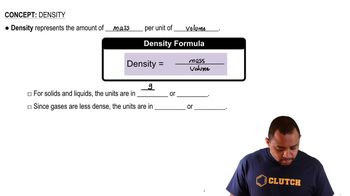
Density

Density is defined as mass per unit volume and is a critical property of substances. It is calculated using the formula density = mass/volume. In this context, the densities of liquid and solid benzoic acid are provided, which will help determine how the volume changes when the substance transitions from liquid to solid.
추천 영상:
가이드 코스
01:56
Density Concepts

Phase Change

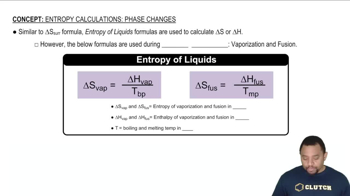
A phase change refers to the transition of a substance from one state of matter to another, such as from liquid to solid. During this process, the arrangement of molecules changes, which can affect the volume occupied by the substance. Understanding how phase changes influence volume is essential for answering the question about the volume of solid benzoic acid compared to its liquid form.
추천 영상:
가이드 코스
01:46
Entropy in Phase Changes

Volume and Temperature Relationship

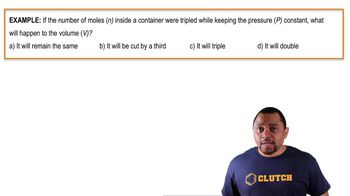
The volume of a substance can change with temperature due to thermal expansion or contraction. In the case of benzoic acid, the transition from liquid to solid typically results in a decrease in volume, as solids are generally more closely packed than liquids. This relationship is crucial for predicting whether the solid will occupy more or less volume than the liquid.
추천 영상:
가이드 코스
01:09
Relationship of Volume and Moles Example