
Ch.11 - Liquids and Intermolecular Forces
Brown - Chemistry: The Central Science 14th Edition
Brown14th EditionChemistry: The Central ScienceISBN: 9780134414232당신이 사용하는 게 아니라요?교과서 변경
11장, 문제 44

Compounds like CCl2F2 are known as chlorofluorocarbons, or CFCs. These compounds were once widely used as refrigerants but are now being replaced by compounds that are believed to be less harmful to the environment. The heat of vaporization of CCl2F2 is 289 J/g. What mass of this substance must evaporate to freeze 200 g of water initially at 15 °C? (The heat of fusion of water is 334 J/g; the specific heat of water is 4.18 J/g-K.)

검증된 단계별 안내
1
Calculate the amount of heat that must be removed from the water to lower its temperature from 15 °C to 0 °C using the formula: \( q = m \cdot c \cdot \Delta T \), where \( m \) is the mass of water, \( c \) is the specific heat capacity, and \( \Delta T \) is the change in temperature.
Calculate the amount of heat that must be removed to freeze the water at 0 °C using the formula: \( q = m \cdot \Delta H_{fusion} \), where \( m \) is the mass of water and \( \Delta H_{fusion} \) is the heat of fusion.
Add the heat calculated in the first two steps to find the total heat that must be removed from the water.
Use the heat of vaporization of CCl2F2 to determine the mass of CCl2F2 that must evaporate to remove the total heat calculated in the previous step. Use the formula: \( q = m \cdot \Delta H_{vaporization} \), where \( q \) is the total heat to be removed and \( \Delta H_{vaporization} \) is the heat of vaporization.
Solve for the mass of CCl2F2 by rearranging the formula from the previous step: \( m = \frac{q}{\Delta H_{vaporization}} \).

주요 개념

질문에 올바르게 답하기 위해 반드시 이해해야 하는 핵심 개념들은 다음과 같습니다.

Heat of Vaporization

The heat of vaporization is the amount of energy required to convert a unit mass of a liquid into vapor without a change in temperature. In this context, the heat of vaporization of CCl2F2 is 289 J/g, meaning that for every gram of CCl2F2 that evaporates, 289 joules of energy are absorbed from the surroundings. This concept is crucial for calculating how much CCl2F2 is needed to absorb enough heat to freeze water.
추천 영상:

Heat of Fusion

The heat of fusion is the amount of energy required to change a substance from solid to liquid at its melting point. For water, the heat of fusion is 334 J/g, indicating that 334 joules are needed to convert 1 gram of ice at 0 °C to liquid water at the same temperature. This concept is essential for determining how much energy must be removed from water to freeze it, which directly relates to the mass of CCl2F2 needed.
추천 영상:

Specific Heat Capacity

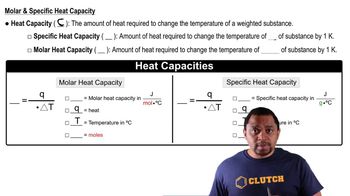
Specific heat capacity is the amount of heat required to raise the temperature of a unit mass of a substance by one degree Celsius. For water, this value is 4.18 J/g-K, which means it takes 4.18 joules to raise the temperature of 1 gram of water by 1 °C. Understanding specific heat is important for calculating the energy changes involved when cooling water from 15 °C to 0 °C before it can freeze.
추천 영상: