
Ch.11 - Liquids and Intermolecular Forces
Brown - Chemistry: The Central Science 14th Edition
Brown14th EditionChemistry: The Central ScienceISBN: 9780134414232당신이 사용하는 게 아니라요?교과서 변경
11장, 문제 27b

Ethylene glycol (HOCH2CH2OH), the major substance in antifreeze, has a normal boiling point of 198 °C. By comparison, ethyl alcohol (CH3CH2OH) boils at 78 °C at atmospheric pressure. Ethylene glycol dimethyl ether (CH3OCH2CH2OCH3) has a normal boiling point of 83 °C, and ethyl methyl ether (CH3CH2OCH3) has a nomral boiling point of 11 °C. (b) What are the major factors responsible for the difference in boiling points of the two ethers?

검증된 단계별 안내
1
Identify the two ethers in question: ethylene glycol dimethyl ether (CH3OCH2CH2OCH3) and ethyl methyl ether (CH3CH2OCH3).
Understand that boiling point is influenced by intermolecular forces. The stronger the intermolecular forces, the higher the boiling point.
Recognize the types of intermolecular forces present in ethers: primarily dipole-dipole interactions and London dispersion forces. Hydrogen bonding is not significant in these ethers due to the lack of hydrogen atoms bonded to highly electronegative atoms like oxygen.
Compare the molecular structure of the two ethers. Ethylene glycol dimethyl ether has a larger molecular size and more surface area compared to ethyl methyl ether, leading to stronger London dispersion forces.
Conclude that the difference in boiling points is mainly due to the stronger London dispersion forces in ethylene glycol dimethyl ether, which result from its larger molecular size and greater surface area compared to ethyl methyl ether.

비슷한 문제에 대한 검증된 영상 답변:

이 영상 해법은 위 문제에 도움이 된다고 튜터들이 추천한 것입니다.
영상 길이:
2m

주요 개념

질문에 올바르게 답하기 위해 반드시 이해해야 하는 핵심 개념들은 다음과 같습니다.

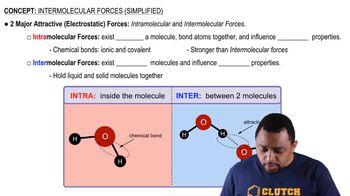
Intermolecular Forces

Intermolecular forces are the attractive forces between molecules that influence physical properties such as boiling points. The main types include hydrogen bonding, dipole-dipole interactions, and London dispersion forces. Molecules with stronger intermolecular forces typically have higher boiling points due to the increased energy required to separate them during the phase change from liquid to gas.
추천 영상:
가이드 코스
01:59
Intermolecular vs Intramolecular Forces

Hydrogen Bonding

Hydrogen bonding is a specific type of strong dipole-dipole interaction that occurs when hydrogen is bonded to highly electronegative atoms like oxygen, nitrogen, or fluorine. In the case of ethylene glycol, the presence of hydroxyl (-OH) groups allows for extensive hydrogen bonding, significantly raising its boiling point compared to ethers that lack such groups, which primarily exhibit weaker van der Waals forces.
추천 영상:
가이드 코스
01:22
Hydrogenation Reactions

Molecular Structure and Polarity

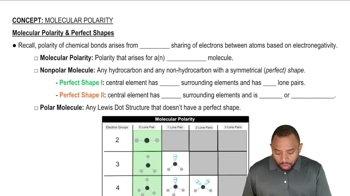
The molecular structure and polarity of a compound play crucial roles in determining its boiling point. Ethers generally have lower boiling points than alcohols due to their non-polar characteristics and lack of hydrogen bonding. The arrangement of atoms and the presence of functional groups can lead to variations in polarity, affecting how molecules interact with each other and, consequently, their boiling points.
추천 영상:
가이드 코스
02:38
Molecular Polarity