
Ch.11 - Liquids and Intermolecular Forces
Brown - Chemistry: The Central Science 14th Edition
Brown14th EditionChemistry: The Central ScienceISBN: 9780134414232당신이 사용하는 게 아니라요?교과서 변경
11장, 문제 90a

In Table 11.3, we saw that the viscosity of a series of hydrocarbons increased with molecular weight, doubling from the six-carbon molecule to the ten-carbon molecule.
(a) The eight-carbon hydrocarbon, octane, has an isomer, isooctane. Would you predict that isooctane would have a larger or smaller viscosity than octane? Why?

검증된 단계별 안내
1
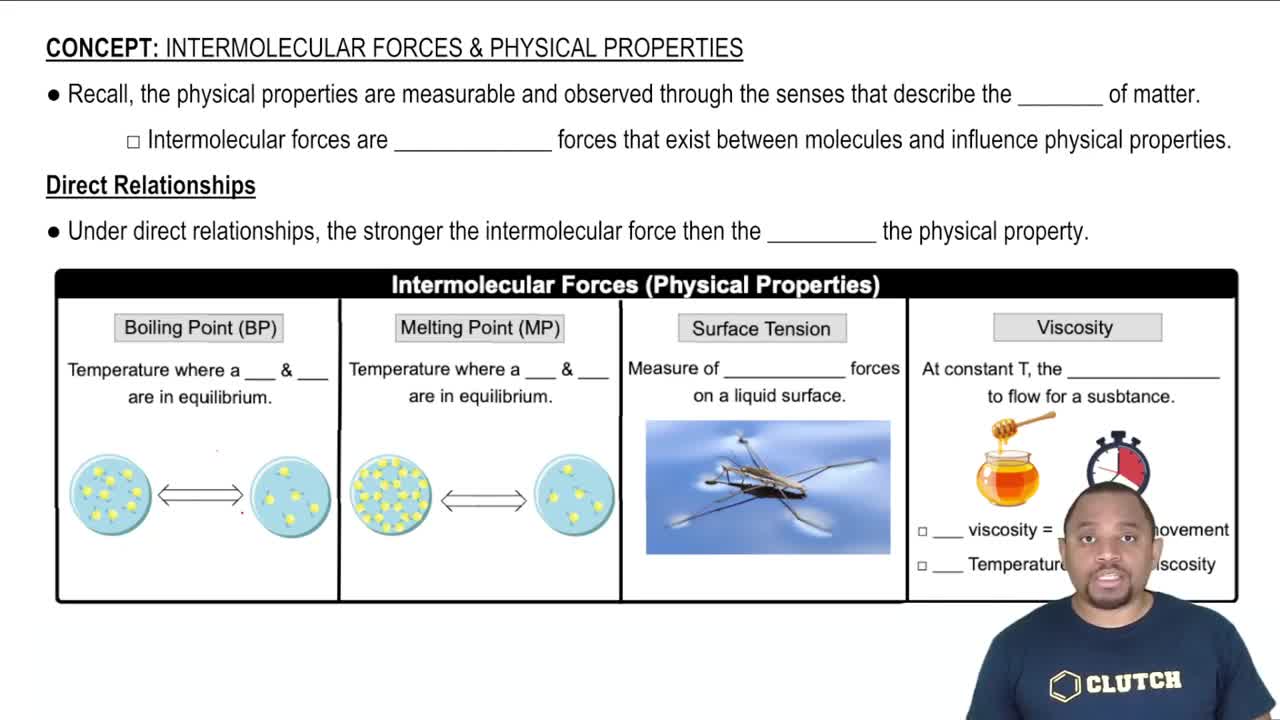
Understand that viscosity is a measure of a fluid's resistance to flow. In hydrocarbons, viscosity generally increases with molecular weight and the strength of intermolecular forces.
Recognize that octane (C8H18) and isooctane (2,2,4-trimethylpentane) are structural isomers, meaning they have the same molecular formula but different structures.
Consider the structure of octane, which is a straight-chain alkane, and compare it to isooctane, which is a branched alkane.
Recall that branching in hydrocarbons tends to decrease the surface area available for intermolecular interactions, leading to weaker van der Waals forces compared to straight-chain isomers.
Predict that isooctane would have a smaller viscosity than octane due to its branched structure, which reduces intermolecular attractions and thus decreases resistance to flow.

비슷한 문제에 대한 검증된 영상 답변:

이 영상 해법은 위 문제에 도움이 된다고 튜터들이 추천한 것입니다.
영상 길이:
3m

주요 개념

질문에 올바르게 답하기 위해 반드시 이해해야 하는 핵심 개념들은 다음과 같습니다.

Viscosity

Viscosity is a measure of a fluid's resistance to flow. It is influenced by the size and shape of the molecules in the fluid; larger and more complex molecules typically result in higher viscosity due to increased intermolecular interactions. In hydrocarbons, as molecular weight increases, viscosity tends to increase because larger molecules can entangle more easily, hindering flow.
추천 영상:
가이드 코스
03:13
Intermolecular Forces and Properties

Isomerism

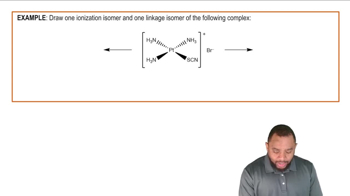
Isomerism refers to the phenomenon where two or more compounds have the same molecular formula but different structural arrangements or spatial orientations. In the case of octane and isooctane, they are structural isomers, meaning they have different connectivity of atoms. This difference can affect their physical properties, including viscosity, as the arrangement of atoms influences how molecules interact with each other.
추천 영상:
가이드 코스
2:14
Isomerism in Coordination Complexes Example

Intermolecular Forces

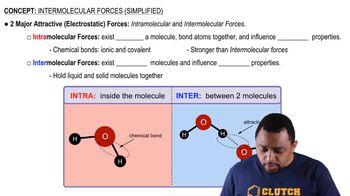
Intermolecular forces are the attractive forces between molecules that influence physical properties such as boiling point, melting point, and viscosity. In hydrocarbons, van der Waals forces (dispersion forces) play a significant role. The strength of these forces can vary based on molecular structure; for example, branched isomers like isooctane generally have weaker intermolecular forces compared to their straight-chain counterparts, potentially leading to lower viscosity.
추천 영상:
가이드 코스
01:59
Intermolecular vs Intramolecular Forces