Ch.11 - Liquids and Intermolecular Forces
Brown - Chemistry: The Central Science 14th Edition
Brown14th EditionChemistry: The Central ScienceISBN: 9780134414232당신이 사용하는 게 아니라요?교과서 변경
11장, 문제 62b

Use the phase diagram of neon to answer the following questions. (b) What can you say about the strength of the intermolecular forces in neon and argon based on the critical points of Ne and Ar (see Table 11.5.)?

검증된 단계별 안내
1
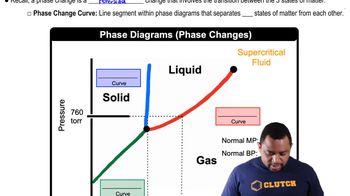
Step 1: Understand the concept of a phase diagram. A phase diagram is a graphical representation of the physical states of a substance under different temperatures and pressures. The critical point on a phase diagram represents the temperature and pressure at which the gas and liquid states of a substance become indistinguishable from each other.
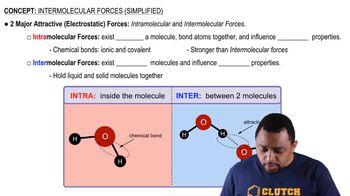
Step 2: Understand the concept of intermolecular forces. Intermolecular forces are the forces of attraction between molecules. They are weaker than intramolecular forces, which are the forces within a molecule. The strength of intermolecular forces affects the physical properties of substances, including their phase changes.
Step 3: Compare the critical points of neon (Ne) and argon (Ar). The critical point of a substance is directly related to the strength of its intermolecular forces. A substance with stronger intermolecular forces will have a higher critical temperature and pressure, because more energy (in the form of heat or pressure) is required to overcome these forces and change the substance's state.
Step 4: Make a conclusion based on the comparison. If the critical point of Ne is lower than that of Ar, it means that the intermolecular forces in Ne are weaker than those in Ar. Conversely, if the critical point of Ne is higher than that of Ar, it means that the intermolecular forces in Ne are stronger than those in Ar.
Step 5: Remember that this is a general rule and there may be exceptions. Other factors, such as the size and shape of the molecules and the presence of polar bonds, can also affect the strength of intermolecular forces and the critical points of substances.

비슷한 문제에 대한 검증된 영상 답변:

이 영상 해법은 위 문제에 도움이 된다고 튜터들이 추천한 것입니다.
영상 길이:
1m

주요 개념

질문에 올바르게 답하기 위해 반드시 이해해야 하는 핵심 개념들은 다음과 같습니다.

Phase Diagram

A phase diagram is a graphical representation that shows the phases of a substance at various temperatures and pressures. It delineates the boundaries between different states of matter (solid, liquid, gas) and indicates critical points where phase transitions occur. Understanding phase diagrams is essential for analyzing the behavior of substances under varying conditions.
추천 영상:
가이드 코스
03:22
Phase Changes in Diagrams

Intermolecular Forces

Intermolecular forces are the attractive forces between molecules that influence their physical properties, such as boiling and melting points. These forces include van der Waals forces, dipole-dipole interactions, and hydrogen bonding. The strength of these forces can be inferred from the critical points of substances, as stronger intermolecular forces typically lead to higher critical temperatures and pressures.
추천 영상:
가이드 코스
01:59
Intermolecular vs Intramolecular Forces

Critical Point

The critical point of a substance is the temperature and pressure at which the distinction between liquid and gas phases disappears, resulting in a supercritical fluid. At this point, the properties of the liquid and gas phases converge, and the substance can no longer exist as a distinct liquid or gas. Analyzing the critical points of neon and argon helps in comparing their intermolecular forces, as substances with higher critical points generally exhibit stronger intermolecular interactions.
추천 영상:
가이드 코스
03:05
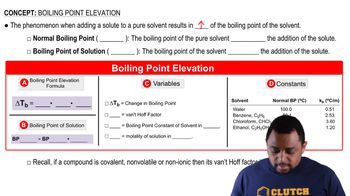
Boiling Point Elevation