Ch.11 - Liquids and Intermolecular Forces
Brown - Chemistry: The Central Science 14th Edition
Brown14th EditionChemistry: The Central ScienceISBN: 9780134414232당신이 사용하는 게 아니라요?교과서 변경
11장, 문제 54

You are high up in the mountains and boil water to make some tea. However, when you drink your tea, it is not as hot as it should be. You try again and again, but the water is just not hot enough to make a hot cup of tea. Which is the best explanation for this result? (a) High in the mountains, it is probably very dry, and so the water is rapidly evaporating from your cup and cooling it. (b) High in the mountains, it is probably very windy, and so the water is rapidly evaporating from your cup and cooling it. (c) High in the mountains, the air pressure is significantly less than 1 atm, so the boiling point of water is much lower than at sea level. (d) High in the mountains, the air pressure is significantly less than 1 atm, so the boiling point of water is much higher than at sea level.

검증된 단계별 안내
1
Identify the problem: The tea is not as hot as expected when boiled at high altitudes.
Recall that boiling point is affected by atmospheric pressure. At higher altitudes, atmospheric pressure is lower than at sea level.
Understand that a lower atmospheric pressure results in a lower boiling point for water. This means water boils at a temperature less than 100°C.
Consider the options: (a) and (b) suggest evaporation due to dryness or wind, which are not the primary reasons for the lower temperature of boiling water. (d) incorrectly states that boiling point is higher at lower pressures.
Conclude that the correct explanation is (c): High in the mountains, the air pressure is significantly less than 1 atm, so the boiling point of water is much lower than at sea level.

비슷한 문제에 대한 검증된 영상 답변:

이 영상 해법은 위 문제에 도움이 된다고 튜터들이 추천한 것입니다.
영상 길이:
1m

주요 개념

질문에 올바르게 답하기 위해 반드시 이해해야 하는 핵심 개념들은 다음과 같습니다.

Boiling Point and Atmospheric Pressure

The boiling point of a liquid is the temperature at which its vapor pressure equals the surrounding atmospheric pressure. At higher altitudes, such as in the mountains, the atmospheric pressure is lower than at sea level, which decreases the boiling point of water. This means that water will boil at a lower temperature, resulting in less heat available for making hot tea.
추천 영상:
가이드 코스
03:05
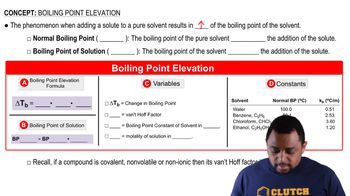
Boiling Point Elevation

Vapor Pressure

Vapor pressure is the pressure exerted by a vapor in equilibrium with its liquid or solid form. As temperature increases, the vapor pressure of a liquid also increases, leading to boiling. In high-altitude conditions, the lower atmospheric pressure allows water to reach its boiling point at a lower temperature, which can affect the temperature of the water used for brewing tea.
추천 영상:
가이드 코스
02:40
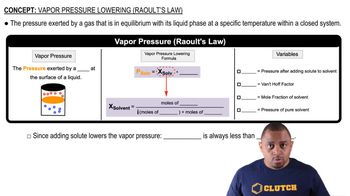
Raoult's Law and Vapor Pressure

Heat Transfer and Evaporation

Heat transfer occurs when thermal energy moves from a hotter object to a cooler one. Evaporation is a cooling process where molecules at the surface of a liquid gain enough energy to escape into the vapor phase. In high-altitude environments, rapid evaporation can occur, which may further cool the remaining liquid, making it difficult to achieve the desired temperature for hot tea.
추천 영상:
가이드 코스
04:50
Filtration and Evaporation