
Ch.12 - Solids and Modern Materials
Brown - Chemistry: The Central Science 14th Edition
Brown14th EditionChemistry: The Central ScienceISBN: 9780134414232당신이 사용하는 게 아니라요?교과서 변경
12장, 문제 61b

A particular form of cinnabar (HgS) adopts the zinc blende structure. The length of the unit cell edge is 5.852 Å. (b) The mineral tiemannite (HgSe) also forms a solid phase with the zinc blende structure. The length of the unit cell edge in this mineral is 6.085 Å. What accounts for the larger unit cell length in tiemmanite?

검증된 단계별 안내
1
Understand the zinc blende structure: It is a type of cubic crystal structure where each atom is tetrahedrally coordinated. In this structure, the unit cell is a cube, and the edge length is determined by the size of the atoms or ions involved.
Compare the atomic radii: The unit cell length is influenced by the size of the atoms. Compare the atomic radii of selenium (Se) and sulfur (S) since they are the differing atoms in HgSe and HgS, respectively.
Consider the atomic sizes: Selenium (Se) is larger than sulfur (S) because it is located below sulfur in the periodic table, which generally means it has a larger atomic radius due to additional electron shells.
Relate atomic size to unit cell length: The larger atomic radius of selenium compared to sulfur results in a larger unit cell edge length for HgSe compared to HgS, as the atoms occupy more space in the crystal lattice.
Conclude the reasoning: The larger unit cell length in tiemannite (HgSe) compared to cinnabar (HgS) is primarily due to the larger size of the selenium atoms compared to sulfur atoms, which increases the overall dimensions of the unit cell.

비슷한 문제에 대한 검증된 영상 답변:

이 영상 해법은 위 문제에 도움이 된다고 튜터들이 추천한 것입니다.
영상 길이:
1m

주요 개념

질문에 올바르게 답하기 위해 반드시 이해해야 하는 핵심 개념들은 다음과 같습니다.

Zinc Blende Structure

The zinc blende structure is a type of crystal lattice arrangement where each atom is tetrahedrally coordinated. In this structure, each zinc atom is surrounded by four sulfur atoms, and vice versa, forming a three-dimensional network. This arrangement is significant in understanding the properties of materials like cinnabar and tiemannite, as it influences their stability and interactions.
추천 영상:
가이드 코스
01:42
Resonance Structures

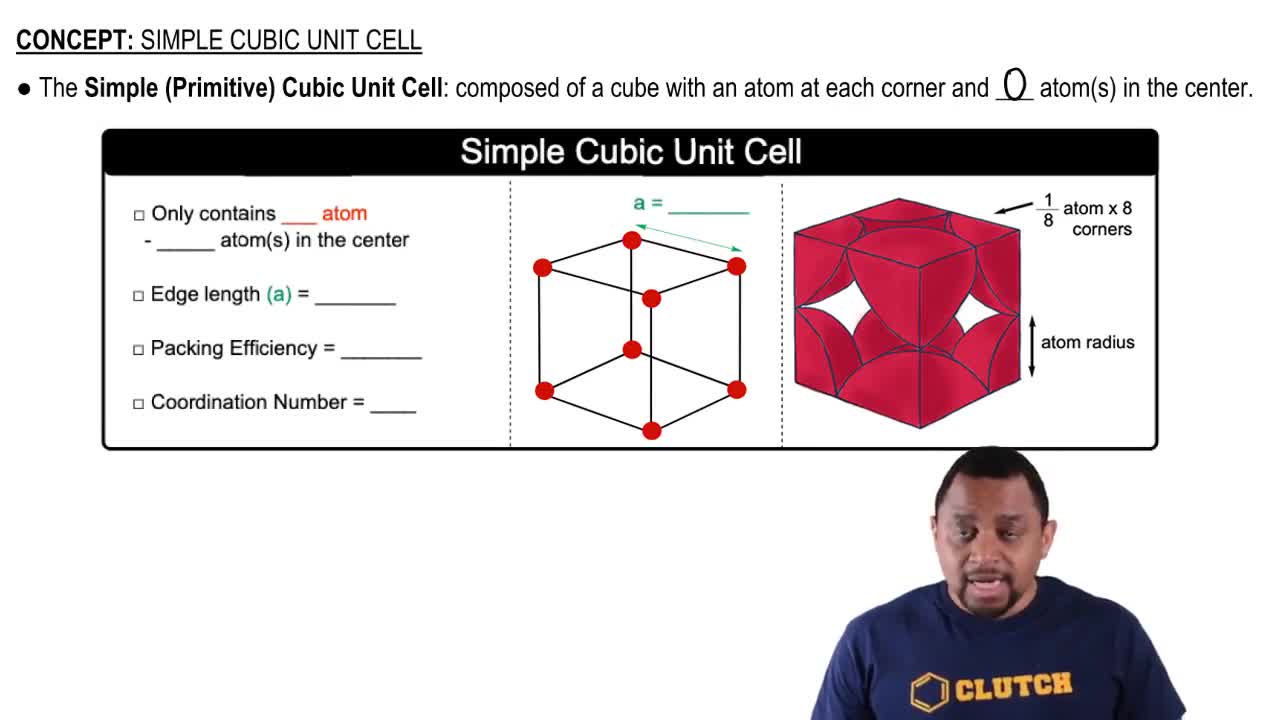
Unit Cell and Edge Length

A unit cell is the smallest repeating unit in a crystal lattice that reflects the symmetry and structure of the entire crystal. The edge length of a unit cell is a critical parameter that defines the size of the crystal structure. Variations in edge length can indicate differences in atomic size, bonding, or the presence of different elements within the crystal, which is essential for comparing cinnabar and tiemannite.
추천 영상:
가이드 코스
01:27
Simple Cubic Unit Cell

Atomic Size and Bonding

Atomic size refers to the radius of an atom, which can influence the distance between atoms in a crystal lattice. In the case of cinnabar (HgS) and tiemannite (HgSe), the larger unit cell length in tiemannite can be attributed to the larger atomic radius of selenium compared to sulfur. This difference in atomic size affects the overall dimensions of the unit cell and the stability of the crystal structure.
추천 영상: