
Ch.12 - Solids and Modern Materials
Brown - Chemistry: The Central Science 14th Edition
Brown14th EditionChemistry: The Central ScienceISBN: 9780134414232당신이 사용하는 게 아니라요?교과서 변경
12장, 문제 39

Aluminum metal crystallizes in a face-centered cubic unit cell. (a) How many aluminum atoms are in a unit cell? (b) Estimate the length of the unit cell edge, a, from the atomic radius of aluminum (1.43 Å). (c) Calculate the density of aluminum metal.

검증된 단계별 안내
1
Step 1: Understand the structure of a face-centered cubic (FCC) unit cell. In an FCC unit cell, atoms are located at each of the corners and the centers of all the faces of the cube. Calculate the total number of atoms per unit cell by considering the contribution of each atom at the corners and faces.
Step 2: Calculate the number of atoms in the FCC unit cell. Each corner atom is shared by eight adjacent unit cells, and each face-centered atom is shared by two unit cells. Therefore, the total number of atoms in one FCC unit cell is calculated as follows: 8 corner atoms * (1/8) + 6 face atoms * (1/2).
Step 3: Use the atomic radius to estimate the length of the unit cell edge, a. In an FCC structure, the face diagonal is equal to four times the atomic radius. Use the relationship between the face diagonal and the edge length: face diagonal = a√2 = 4 * atomic radius.
Step 4: Rearrange the equation from Step 3 to solve for the edge length, a. Substitute the given atomic radius of aluminum (1.43 Å) into the equation to find the edge length.
Step 5: Calculate the density of aluminum metal. Use the formula for density: density = mass/volume. First, calculate the mass of the aluminum atoms in the unit cell using the molar mass of aluminum and Avogadro's number. Then, calculate the volume of the unit cell using the edge length from Step 4. Finally, divide the mass by the volume to find the density.

주요 개념

질문에 올바르게 답하기 위해 반드시 이해해야 하는 핵심 개념들은 다음과 같습니다.

Face-Centered Cubic (FCC) Structure

In a face-centered cubic (FCC) structure, atoms are located at each corner of the cube and at the center of each face. This arrangement results in a higher packing efficiency, with each unit cell containing four atoms. Understanding this structure is crucial for determining the number of atoms in a unit cell and for calculating properties like density.
추천 영상:
가이드 코스
00:51
Face Centered Cubic Example

Atomic Radius and Unit Cell Edge Length

The atomic radius is the distance from the nucleus of an atom to the outermost shell of electrons. In an FCC structure, the relationship between the atomic radius and the unit cell edge length (a) can be expressed as a = 2√2r, where r is the atomic radius. This relationship allows us to estimate the edge length of the unit cell based on the known atomic radius of aluminum.
추천 영상:
가이드 코스
01:27
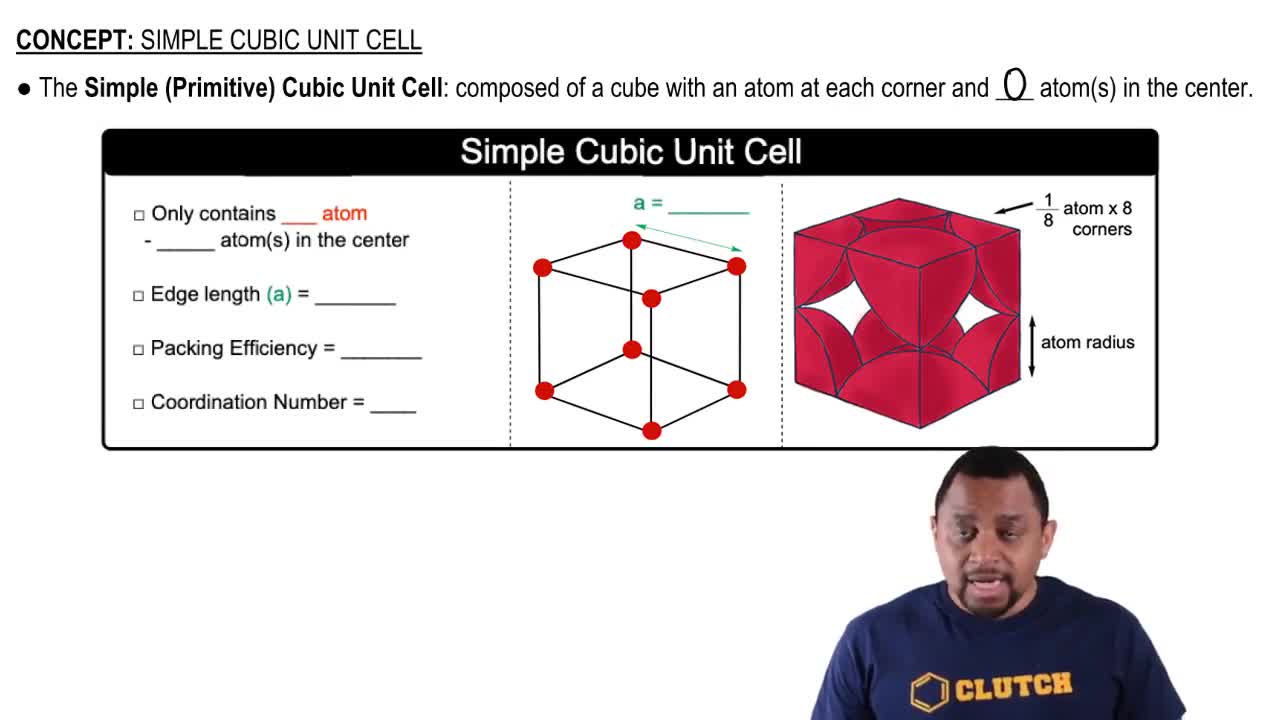
Simple Cubic Unit Cell

Density Calculation

Density is defined as mass per unit volume. For a crystalline solid like aluminum, density can be calculated using the formula: density = (mass of atoms in unit cell) / (volume of unit cell). The mass can be determined from the number of atoms in the unit cell and the molar mass of aluminum, while the volume is derived from the cube of the edge length (a^3).
추천 영상:
가이드 코스
01:56
Density Concepts