Ch.12 - Solids and Modern Materials
Brown - Chemistry: The Central Science 14th Edition
Brown14th EditionChemistry: The Central ScienceISBN: 9780134414232당신이 사용하는 게 아니라요?교과서 변경
12장, 문제 85

An ester is a compound formed by a condensation reaction between a carboxylic acid and an alcohol that eliminates a water molecule. Read the discussion of esters in Section 24.4 and then give an example of a reaction forming an ester. How might this kind of reaction be extended to form a polymer (a polyester)?

검증된 단계별 안내
1
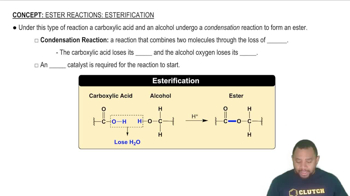
Step 1: Understand the basic esterification reaction, which involves a carboxylic acid (RCOOH) reacting with an alcohol (R'OH) to form an ester (RCOOR') and water (H2O).
Step 2: Write a balanced chemical equation for a simple esterification reaction. For example, acetic acid (CH3COOH) reacting with ethanol (C2H5OH) to form ethyl acetate (CH3COOC2H5) and water.
Step 3: Recognize that the esterification reaction is a type of condensation reaction, where two molecules combine with the elimination of a small molecule, in this case, water.
Step 4: To extend this reaction to form a polymer, consider using a diacid (a molecule with two carboxylic acid groups) and a diol (a molecule with two alcohol groups).
Step 5: Write a general equation for the polymerization process, where the diacid and diol react to form a polyester, with the repeated elimination of water molecules, resulting in a long chain polymer.

주요 개념

질문에 올바르게 답하기 위해 반드시 이해해야 하는 핵심 개념들은 다음과 같습니다.

Esterification Reaction

Esterification is a chemical reaction that forms an ester from a carboxylic acid and an alcohol. This process typically involves a condensation reaction, where a water molecule is eliminated as the ester bond is formed. The general reaction can be represented as RCOOH + R'OH → RCOOR' + H2O, where R and R' are hydrocarbon chains. Understanding this reaction is crucial for identifying how esters are synthesized.
추천 영상:
가이드 코스
01:50
Ester Reactions: Esterification

Polyester Formation

Polyester formation involves the repeated esterification of diacids and diols, leading to long-chain polymers. In this process, each reaction between a carboxylic acid and an alcohol results in the release of water, allowing the formation of a polymeric structure. This concept is essential for understanding how small ester molecules can link together to create larger, more complex materials, such as plastics and fibers.
추천 영상:
가이드 코스
02:34
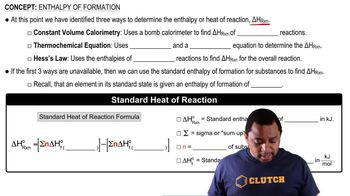
Enthalpy of Formation

Condensation Reaction

A condensation reaction is a type of chemical reaction where two molecules combine to form a larger molecule, accompanied by the loss of a small molecule, often water. This reaction is fundamental in organic chemistry, particularly in the formation of esters and polymers. Recognizing the role of condensation reactions helps in understanding how various organic compounds can be synthesized and how they interact in larger molecular structures.
추천 영상:
가이드 코스
01:53
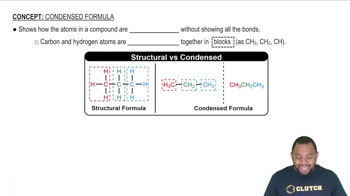
Condensed Formula