Ch.12 - Solids and Modern Materials
Brown - Chemistry: The Central Science 14th Edition
Brown14th EditionChemistry: The Central ScienceISBN: 9780134414232당신이 사용하는 게 아니라요?교과서 변경
12장, 문제 109

For each of the intermetallic compounds shown in Figure 12.17 determine the number of each type of atom in the unit cell. Do your answers correspond to the ratios expected from the empirical formulas: Ni3Al?Face centered cubic unit cell showing Pt and Fe atoms for Ni3Al analysis.

검증된 단계별 안내
1
Identify the positions of the Pt and Fe atoms in the unit cell. Pt atoms are represented by blue spheres, and Fe atoms are represented by pink spheres.
Count the number of Pt atoms in the unit cell. Note that Pt atoms are located at the face centers of the cubic unit cell.
Count the number of Fe atoms in the unit cell. Note that Fe atoms are located at the corners of the cubic unit cell.
Calculate the contribution of each Pt atom to the unit cell. Each face-centered atom contributes 1/2 of an atom to the unit cell.
Calculate the contribution of each Fe atom to the unit cell. Each corner atom contributes 1/8 of an atom to the unit cell.

비슷한 문제에 대한 검증된 영상 답변:

이 영상 해법은 위 문제에 도움이 된다고 튜터들이 추천한 것입니다.
영상 길이:
1m

주요 개념

질문에 올바르게 답하기 위해 반드시 이해해야 하는 핵심 개념들은 다음과 같습니다.

Unit Cell

A unit cell is the smallest repeating unit in a crystal lattice that reflects the symmetry and structure of the entire crystal. It defines the arrangement of atoms in three-dimensional space and is characterized by its dimensions and the types of atoms it contains. Understanding the unit cell is crucial for determining the composition and properties of crystalline materials.
추천 영상:
가이드 코스
01:27
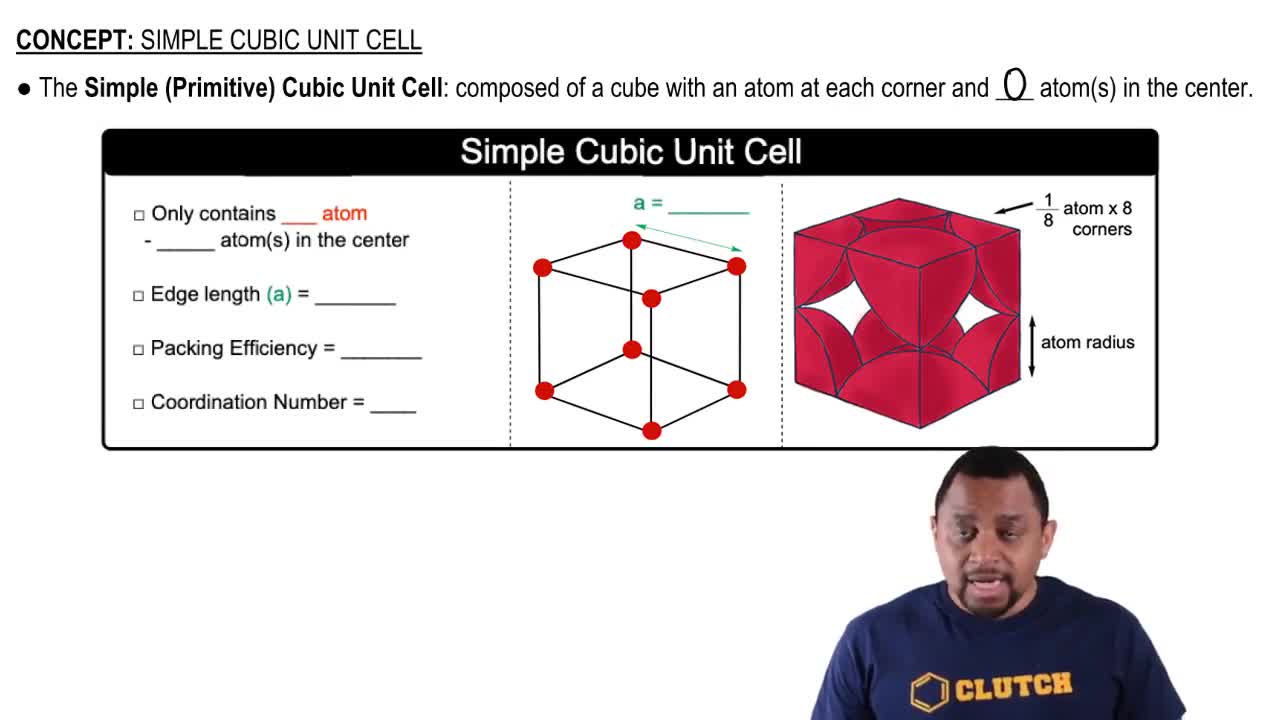
Simple Cubic Unit Cell

Empirical Formula

An empirical formula represents the simplest whole-number ratio of atoms of each element in a compound. For example, the empirical formula Ni3Al indicates that for every three nickel (Ni) atoms, there is one aluminum (Al) atom. This concept is essential for analyzing the composition of intermetallic compounds and verifying if the observed atomic ratios in the unit cell match the expected ratios from the empirical formula.
추천 영상:
가이드 코스
02:26
Empirical vs Molecular Formula

Face-Centered Cubic (FCC) Structure

The face-centered cubic (FCC) structure is a type of crystal lattice where atoms are located at each corner and the centers of all the cube faces. This arrangement allows for a high packing efficiency and is common in metals. Understanding the FCC structure is important for determining the number of atoms per unit cell and how they relate to the empirical formula of intermetallic compounds like Ni3Al.
추천 영상:
가이드 코스
00:51
Face Centered Cubic Example