Ch.12 - Solids and Modern Materials
Brown - Chemistry: The Central Science 14th Edition
Brown14th EditionChemistry: The Central ScienceISBN: 9780134414232당신이 사용하는 게 아니라요?교과서 변경
12장, 문제 2

For each of the two-dimensional structures shown here (a) draw the unit cell (i)
Two-dimensional structures of crystalline solids for unit cell drawing exercise.


(ii)

검증된 단계별 안내
1
Identify the repeating pattern in each two-dimensional structure.
For the first structure (left image), observe the arrangement of the black and white circles. Notice the alternating pattern.
Draw a square around one black circle and the four surrounding white circles to define the unit cell for the first structure.
For the second structure (right image), observe the arrangement of the black circles. Notice the hexagonal pattern.
Draw a hexagon around one black circle and the six surrounding black circles to define the unit cell for the second structure.

비슷한 문제에 대한 검증된 영상 답변:

이 영상 해법은 위 문제에 도움이 된다고 튜터들이 추천한 것입니다.
영상 길이:
2m
도움이 되었나요?

주요 개념

질문에 올바르게 답하기 위해 반드시 이해해야 하는 핵심 개념들은 다음과 같습니다.

Unit Cell

A unit cell is the smallest repeating unit of a crystal lattice that reflects the symmetry and structure of the entire crystal. It defines the arrangement of atoms, ions, or molecules in a crystalline solid. Understanding the unit cell is crucial for visualizing how the larger crystal structure is built and for calculating properties such as density and packing efficiency.
추천 영상:
가이드 코스
01:27
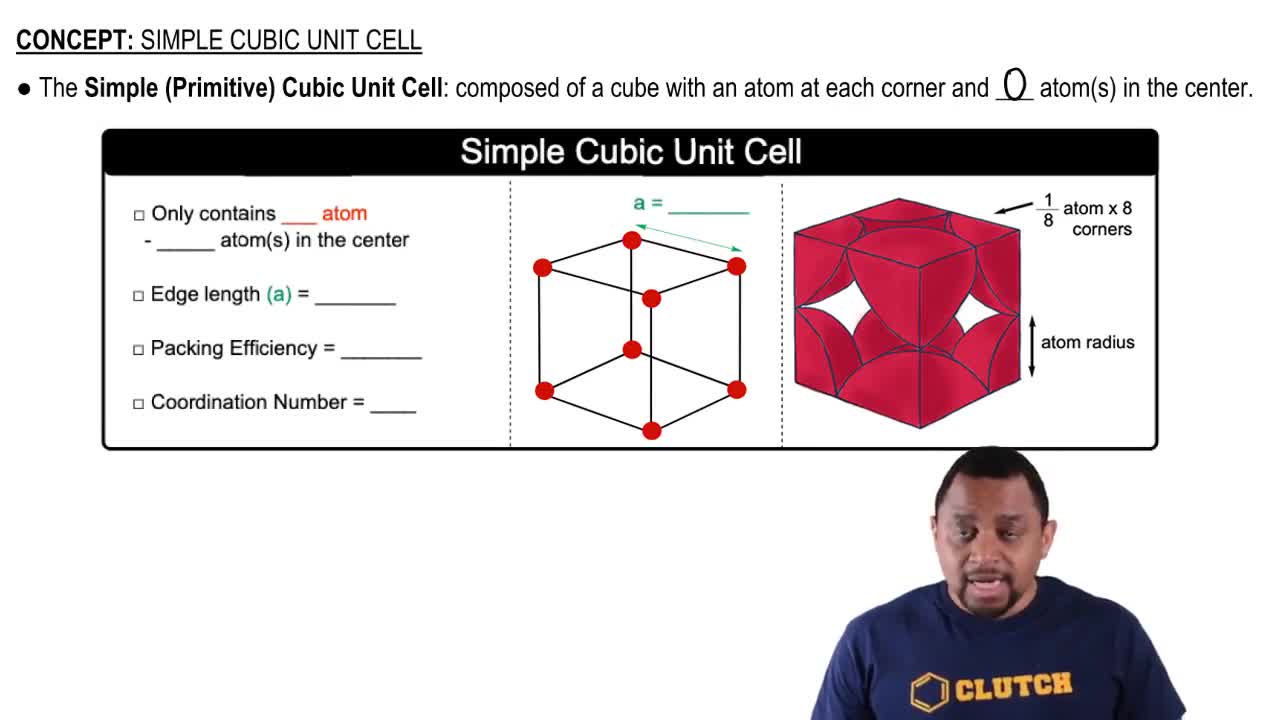
Simple Cubic Unit Cell

Crystalline Structure

Crystalline structures are ordered arrangements of atoms or molecules in a solid, characterized by a repeating pattern. These structures can be classified into different types based on their symmetry and the arrangement of their unit cells, such as cubic, tetragonal, or hexagonal. Recognizing the type of crystalline structure is essential for predicting physical properties like melting point and conductivity.
추천 영상:
가이드 코스
01:31
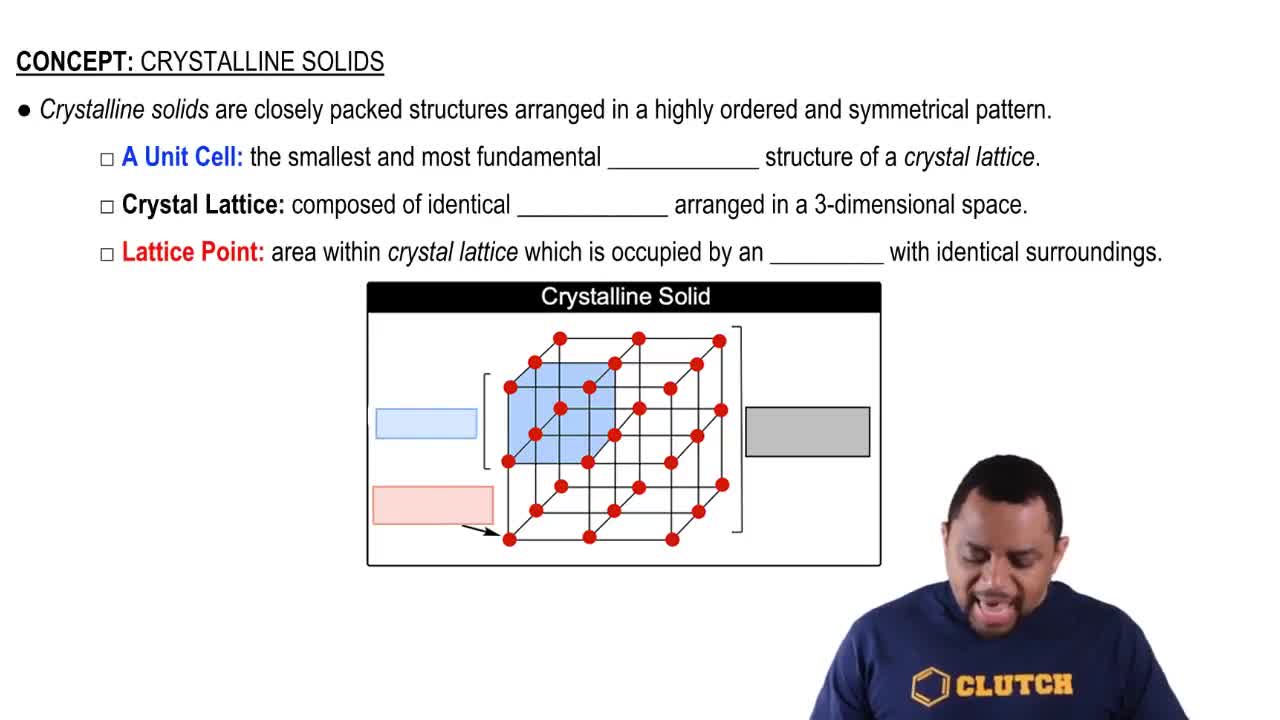
Crystalline Solids Structure

Coordination Number

The coordination number refers to the number of nearest neighbor atoms or ions surrounding a central atom in a crystal lattice. It is a key factor in determining the stability and properties of the crystal. For example, in a face-centered cubic structure, the coordination number is 12, indicating a high packing efficiency and stability, which influences the material's mechanical properties.
추천 영상:
가이드 코스
00:27
Coordination Numbers