Ch.12 - Solids and Modern Materials
Brown - Chemistry: The Central Science 14th Edition
Brown14th EditionChemistry: The Central ScienceISBN: 9780134414232당신이 사용하는 게 아니라요?교과서 변경
12장, 문제 23

Imagine the primitive cubic lattice. Now imagine grabbing the top of it and stretching it straight up. All angles remain 90. What kind of primitive lattice have you made?
Illustration showing a primitive cubic lattice being stretched into a rectangular prism.

검증된 단계별 안내
1
Identify the initial structure as a primitive cubic lattice, where all sides are equal and all angles are 90 degrees.
Visualize the process of stretching the lattice vertically, which means increasing the height while keeping the base dimensions the same.
Note that the angles remain 90 degrees, so the shape transforms into a rectangular prism.
Recognize that the new lattice structure is a primitive tetragonal lattice, characterized by two equal base dimensions and a different height dimension, with all angles remaining 90 degrees.
Conclude that stretching a primitive cubic lattice vertically while maintaining 90-degree angles results in a primitive tetragonal lattice.

비슷한 문제에 대한 검증된 영상 답변:

이 영상 해법은 위 문제에 도움이 된다고 튜터들이 추천한 것입니다.
영상 길이:
1m

주요 개념

질문에 올바르게 답하기 위해 반드시 이해해야 하는 핵심 개념들은 다음과 같습니다.

Primitive Cubic Lattice

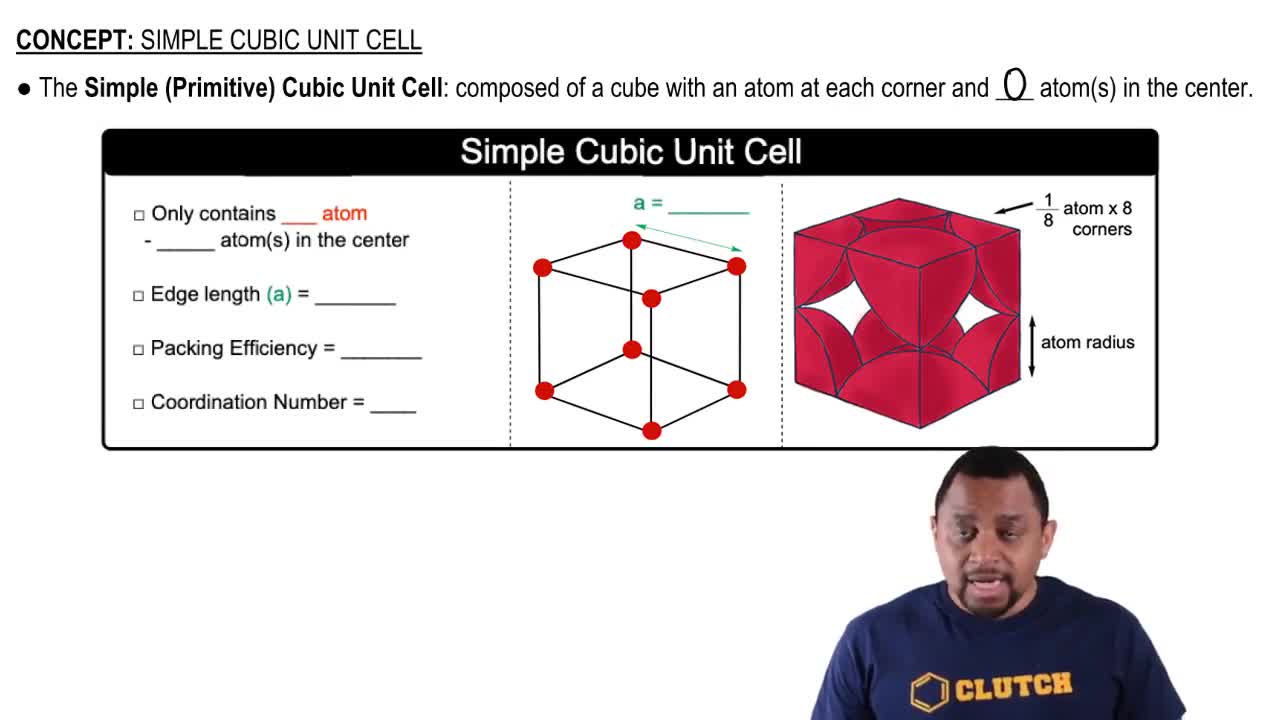
A primitive cubic lattice is a type of crystal structure where atoms are located at the corners of a cube. Each unit cell contains one atom, as the corner atoms are shared among adjacent cells. This arrangement is characterized by its simple geometry and is the basis for understanding more complex lattice structures.
추천 영상:

Lattice Distortion

Lattice distortion refers to the alteration of the regular arrangement of atoms in a crystal lattice. In this scenario, stretching the primitive cubic lattice vertically while maintaining 90-degree angles transforms it into a rectangular prism, indicating a change in the unit cell dimensions while preserving the overall symmetry of the structure.
추천 영상:

Unit Cell

The unit cell is the smallest repeating unit in a crystal lattice that reflects the overall symmetry and structure of the entire crystal. In the case of the stretched primitive cubic lattice, the unit cell changes from a cube to a rectangular prism, which affects the properties of the material, such as density and symmetry.
추천 영상:
가이드 코스
01:27
Simple Cubic Unit Cell