Ch.12 - Solids and Modern Materials
Brown - Chemistry: The Central Science 14th Edition
Brown14th EditionChemistry: The Central ScienceISBN: 9780134414232당신이 사용하는 게 아니라요?교과서 변경
12장, 문제 29b

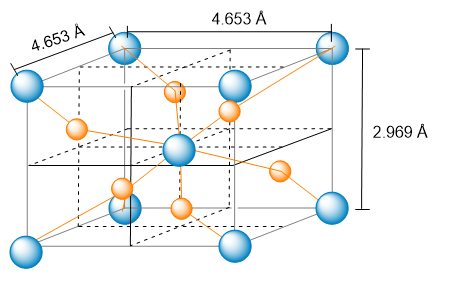
The unit cell of nickel arsenide is shown here. (b) What is the empirical formula?
Diagram of a simple cubic unit cell of nickel arsenide with labeled dimensions.

검증된 단계별 안내
1
Identify the types of atoms present in the unit cell. In this case, the blue spheres represent nickel (Ni) atoms and the orange spheres represent arsenic (As) atoms.
Count the number of each type of atom within the unit cell. Note that atoms on the corners, edges, and faces are shared with adjacent unit cells.
Determine the contribution of each atom to the unit cell. Corner atoms contribute 1/8, edge atoms contribute 1/4, face atoms contribute 1/2, and atoms entirely within the cell contribute 1.
Calculate the total number of nickel (Ni) atoms in the unit cell by summing the contributions of all Ni atoms.
Calculate the total number of arsenic (As) atoms in the unit cell by summing the contributions of all As atoms.

비슷한 문제에 대한 검증된 영상 답변:

이 영상 해법은 위 문제에 도움이 된다고 튜터들이 추천한 것입니다.
영상 길이:
2m

주요 개념

질문에 올바르게 답하기 위해 반드시 이해해야 하는 핵심 개념들은 다음과 같습니다.

Unit Cell

A unit cell is the smallest repeating unit in a crystal lattice that reflects the symmetry and structure of the entire crystal. It defines the arrangement of atoms, ions, or molecules in three-dimensional space. Understanding the dimensions and contents of the unit cell is crucial for determining the empirical formula of a compound, as it provides insight into the ratio of different types of atoms present.
추천 영상:
가이드 코스
01:27
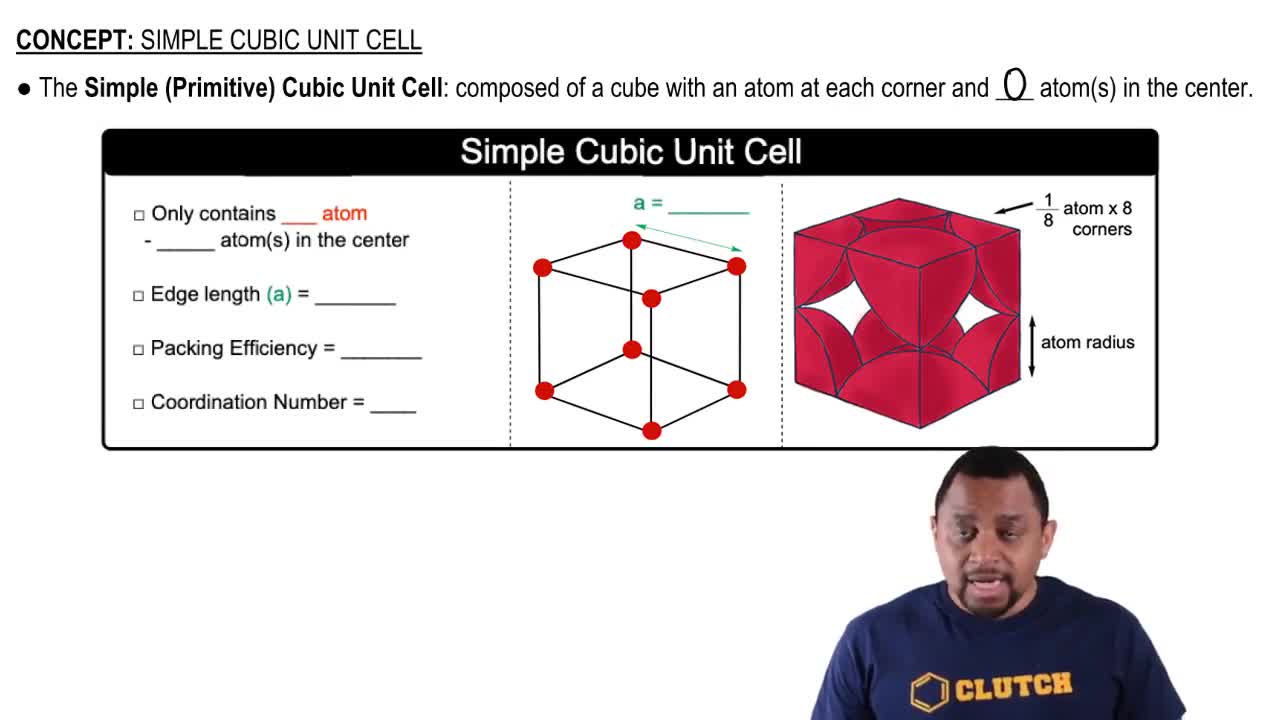
Simple Cubic Unit Cell

Empirical Formula

The empirical formula represents the simplest whole-number ratio of the elements in a compound. It is derived from the composition of the unit cell, indicating how many atoms of each element are present in the smallest repeating unit. For compounds like nickel arsenide, determining the empirical formula involves analyzing the number of nickel and arsenic atoms within the unit cell.
추천 영상:
가이드 코스
02:26
Empirical vs Molecular Formula

Coordination Number

The coordination number is the number of nearest neighboring atoms surrounding a central atom in a crystal structure. It is essential for understanding the geometry and stability of the crystal lattice. In the case of nickel arsenide, knowing the coordination number helps in identifying how the nickel and arsenic atoms are arranged and how they interact within the unit cell, which is vital for calculating the empirical formula.
추천 영상:
가이드 코스
00:27
Coordination Numbers