Ch.13 - Properties of Solutions
Brown - Chemistry: The Central Science 14th Edition
Brown14th EditionChemistry: The Central ScienceISBN: 9780134414232당신이 사용하는 게 아니라요?교과서 변경
13장, 문제 69

(a) Does a 0.10 m aqueous solution of NaCl have a higher boiling point, a lower boiling point, or the same boiling point as a 0.10 m aqueous solution of C6H12O6?

검증된 단계별 안내
1
Identify the colligative property involved: Boiling point elevation is a colligative property, which means it depends on the number of solute particles in a solution, not their identity.
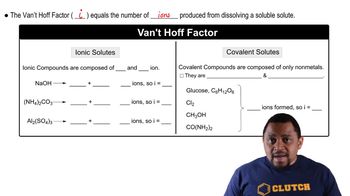
Determine the van't Hoff factor (i) for each solute: NaCl dissociates into two ions (Na^+ and Cl^-), so i = 2. C6H12O6 (glucose) does not dissociate in solution, so i = 1.
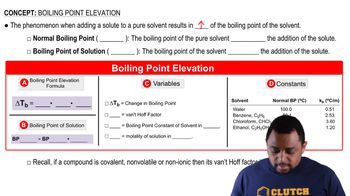
Use the boiling point elevation formula: \( \Delta T_b = i \cdot K_b \cdot m \), where \( \Delta T_b \) is the boiling point elevation, \( K_b \) is the ebullioscopic constant of the solvent, and \( m \) is the molality of the solution.
Compare the boiling point elevations: Since the molality (m) and the solvent (water) are the same for both solutions, the difference in boiling point elevation will depend on the van't Hoff factor (i).
Conclude which solution has a higher boiling point: The solution with the higher van't Hoff factor (NaCl) will have a greater boiling point elevation, thus a higher boiling point than the glucose solution.

비슷한 문제에 대한 검증된 영상 답변:

이 영상 해법은 위 문제에 도움이 된다고 튜터들이 추천한 것입니다.
영상 길이:
1m
도움이 되었나요?

주요 개념

질문에 올바르게 답하기 위해 반드시 이해해야 하는 핵심 개념들은 다음과 같습니다.

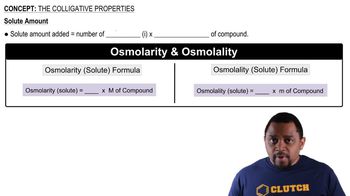
Colligative Properties

Colligative properties are physical properties of solutions that depend on the number of solute particles in a given amount of solvent, rather than the identity of the solute. These properties include boiling point elevation, freezing point depression, vapor pressure lowering, and osmotic pressure. In this context, the boiling point elevation is particularly relevant, as it indicates how the presence of solute particles affects the boiling point of the solvent.
추천 영상:
가이드 코스
01:26
Colligative Properties

Boiling Point Elevation

Boiling point elevation occurs when a non-volatile solute is added to a solvent, resulting in an increase in the boiling point of the solution compared to the pure solvent. This phenomenon is quantified by the formula ΔT_b = i * K_b * m, where ΔT_b is the boiling point elevation, i is the van 't Hoff factor (number of particles the solute dissociates into), K_b is the ebullioscopic constant of the solvent, and m is the molality of the solution. The greater the number of solute particles, the higher the boiling point.
추천 영상:
가이드 코스
03:05
Boiling Point Elevation

Van 't Hoff Factor (i)

The van 't Hoff factor (i) represents the number of particles into which a solute dissociates in solution. For example, NaCl dissociates into two ions (Na+ and Cl-), giving it an i value of 2, while glucose (C6H12O6) does not dissociate and has an i value of 1. This factor is crucial for calculating colligative properties, as it directly influences the extent of boiling point elevation in solutions.
추천 영상:
가이드 코스
02:50
Van't Hoff Factor