Ch.13 - Properties of Solutions
Brown - Chemistry: The Central Science 14th Edition
Brown14th EditionChemistry: The Central ScienceISBN: 9780134414232당신이 사용하는 게 아니라요?교과서 변경
13장, 문제 109a

A series of anions is shown below:
Structures of three anions for analysis of central atom and electron pair domains.
The anion on the far right is called 'BARF' by chemists, as its common abbreviation sounds similar to this word. (a) What is the central atom and the number of electronpair domains around the central atom in each of these anions?

검증된 단계별 안내
1
Identify the central atom in each anion. For the first anion, the central atom is carbon (C). For the second anion, the central atom is nitrogen (N). For the third anion, the central atom is phosphorus (P).
Determine the number of electron pair domains around the central atom. Electron pair domains include both bonding pairs and lone pairs of electrons.
For the first anion (carbon with three chlorine atoms), count the bonding pairs. There are three bonding pairs (C-Cl) and no lone pairs on the central carbon atom.
For the second anion (nitrogen with four methyl groups), count the bonding pairs. There are four bonding pairs (N-CH3) and no lone pairs on the central nitrogen atom.
For the third anion (phosphorus with six bromine atoms), count the bonding pairs. There are six bonding pairs (P-Br) and no lone pairs on the central phosphorus atom.

비슷한 문제에 대한 검증된 영상 답변:

이 영상 해법은 위 문제에 도움이 된다고 튜터들이 추천한 것입니다.
영상 길이:
1m

주요 개념

질문에 올바르게 답하기 위해 반드시 이해해야 하는 핵심 개념들은 다음과 같습니다.

Central Atom

The central atom in a molecule or ion is typically the atom that is bonded to multiple other atoms. It is often the least electronegative element in the compound and serves as the focal point for determining the molecular geometry. In the provided anions, identifying the central atom is crucial for understanding the overall structure and bonding characteristics.
추천 영상:

Electron Pair Domains

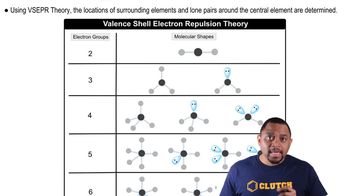
Electron pair domains refer to regions around the central atom where electron pairs are located, including both bonding pairs (shared between atoms) and lone pairs (not shared). The number of electron pair domains influences the molecular geometry according to the VSEPR (Valence Shell Electron Pair Repulsion) theory, which predicts the arrangement of atoms based on minimizing repulsion between electron pairs.
추천 영상:
가이드 코스
00:47
Valence Shell Electron Pair Repulsion Theory

VSEPR Theory

VSEPR (Valence Shell Electron Pair Repulsion) theory is a model used to predict the geometry of individual molecules based on the repulsion between electron pairs in the valence shell of the central atom. By considering the number of bonding and lone pairs, VSEPR theory helps determine the shape of the molecule, which is essential for understanding the properties and reactivity of the anions in the question.
추천 영상:
가이드 코스
02:13
Molecular Shapes and VSEPR