A series of anions is shown below: The anion on the far right is called 'BARF' by chemists, as its common abbreviation sounds similar to this word. (c) Which, if any, of these anions has an expanded octet around its central atom?
Ch.13 - Properties of Solutions
13장, 문제 112
A small cube of lithium 1density = 0.535 g/cm32 measuring 1.0 mm on each edge is added to 0.500 L of water. The following reaction occurs: 2 Li1s2 + 2 H2O1l2 ¡ 2 LiOH1aq2 + H21g2 What is the freezing point of the resulting solution, assuming that the reaction goes to completion?
검증된 단계별 안내1
Calculate the volume of the lithium cube using the formula for the volume of a cube: \(V = \text{side}^3\). Convert the side length from millimeters to centimeters before calculating.
Determine the mass of the lithium cube using its density: \(\text{mass} = \text{density} \times \text{volume}\). Use the given density of lithium.
Convert the mass of lithium to moles using its molar mass: \(\text{moles of Li} = \frac{\text{mass of Li}}{\text{molar mass of Li}}\). The molar mass of lithium is approximately 6.94 g/mol.
Use the stoichiometry of the balanced chemical equation to find the moles of LiOH produced. According to the equation, 2 moles of Li produce 2 moles of LiOH.
Calculate the freezing point depression using the formula \(\Delta T_f = i \cdot K_f \cdot m\), where \(i\) is the van't Hoff factor for LiOH, \(K_f\) is the freezing point depression constant for water, and \(m\) is the molality of the solution.

비슷한 문제에 대한 검증된 영상 답변:
이 영상 해법은 위 문제에 도움이 된다고 튜터들이 추천한 것입니다.
영상 길이:
4m주요 개념
질문에 올바르게 답하기 위해 반드시 이해해야 하는 핵심 개념들은 다음과 같습니다.
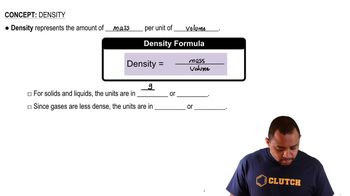
Density and Volume Calculations
Density is defined as mass per unit volume, and it is crucial for determining the mass of lithium in the given cube. The volume of the cube can be calculated using the formula for the volume of a cube (V = side^3). Knowing the density allows us to find the mass of lithium, which is essential for stoichiometric calculations in the reaction with water.
추천 영상:
가이드 코스
Density Concepts
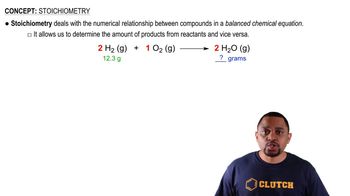
Stoichiometry of Chemical Reactions
Stoichiometry involves the calculation of reactants and products in a chemical reaction based on balanced equations. In this case, the balanced equation shows that 2 moles of lithium react with 2 moles of water to produce 2 moles of lithium hydroxide and 1 mole of hydrogen gas. Understanding stoichiometry is vital for determining the amounts of products formed and the concentration of ions in the solution.
추천 영상:
가이드 코스
Stoichiometry Concept
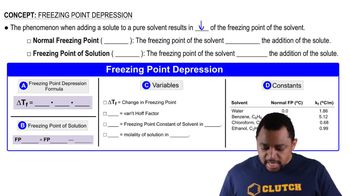
Freezing Point Depression
Freezing point depression is a colligative property that describes how the freezing point of a solvent decreases when a solute is added. The extent of freezing point depression depends on the number of solute particles in solution. In this scenario, calculating the molality of the lithium hydroxide produced will allow us to determine the change in freezing point of the water, which is essential for finding the final freezing point of the solution.
추천 영상:
가이드 코스
Freezing Point Depression
관련 실천
교과서 질문
276
views
교과서 질문
A series of anions is shown below:
The anion on the far right is called 'BARF' by chemists, as its common abbreviation sounds similar to this word. (b) What is the electron-domain geometry around the central B in BARF?
385
views
교과서 질문
What is the boiling point of a 0.10 M solution of NaHSO4 if
the solution has a density of 1.002 g>mL?
495
views
교과서 질문
Compounds like sodium stearate, called 'surfactants' in general, can form structures known as micelles in water, once the solution concentration reaches the value known as the critical micelle concentration (cmc). Micelles contain dozens to hundreds of molecules. The cmc depends on the substance, the solvent, and the temperature. (a) The turbidity (the amount of light scattering) of solutions increases dramatically at the cmc. Suggest an explanation. .
712
views