Ch.13 - Properties of Solutions
Brown - Chemistry: The Central Science 14th Edition
Brown14th EditionChemistry: The Central ScienceISBN: 9780134414232당신이 사용하는 게 아니라요?교과서 변경
13장, 문제 79

Adrenaline is the hormone that triggers the release of extra glucose molecules in times of stress or emergency. A solution of 0.64 g of adrenaline in 36.0 g of CCl4 elevates the boiling point by 0.49 °C. Calculate the approximate molar mass of adrenaline from this data.

검증된 단계별 안내
1
Identify the formula for boiling point elevation: \( \Delta T_b = i \cdot K_b \cdot m \), where \( \Delta T_b \) is the boiling point elevation, \( i \) is the van't Hoff factor (which is 1 for non-electrolytes like adrenaline), \( K_b \) is the ebullioscopic constant of the solvent, and \( m \) is the molality of the solution.
Rearrange the formula to solve for molality \( m \): \( m = \frac{\Delta T_b}{i \cdot K_b} \).
Calculate the molality \( m \) using the given \( \Delta T_b = 0.49 \text{ °C} \) and the known \( K_b \) for carbon tetrachloride (CCl_4), which you can look up in a reference table.
Use the definition of molality: \( m = \frac{\text{moles of solute}}{\text{kilograms of solvent}} \). Convert the mass of CCl_4 from grams to kilograms and use the calculated molality to find the moles of adrenaline.
Calculate the molar mass of adrenaline by dividing the mass of adrenaline (0.64 g) by the moles of adrenaline obtained in the previous step.

비슷한 문제에 대한 검증된 영상 답변:

이 영상 해법은 위 문제에 도움이 된다고 튜터들이 추천한 것입니다.
영상 길이:
4m

주요 개념

질문에 올바르게 답하기 위해 반드시 이해해야 하는 핵심 개념들은 다음과 같습니다.

Colligative Properties

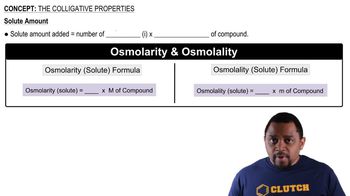
Colligative properties are physical properties of solutions that depend on the number of solute particles in a given amount of solvent, rather than the identity of the solute. Examples include boiling point elevation and freezing point depression. In this context, the boiling point elevation of CCl4 due to the addition of adrenaline is a key factor in determining the molar mass of adrenaline.
추천 영상:
가이드 코스
01:26
Colligative Properties

Boiling Point Elevation Formula

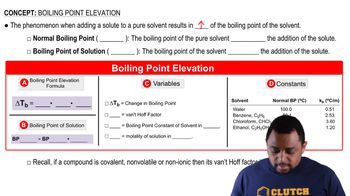
The boiling point elevation can be calculated using the formula ΔT_b = i * K_b * m, where ΔT_b is the change in boiling point, i is the van 't Hoff factor (which is 1 for non-electrolytes like adrenaline), K_b is the ebullioscopic constant of the solvent, and m is the molality of the solution. This formula allows us to relate the observed boiling point change to the concentration of the solute, which is essential for calculating molar mass.
추천 영상:
가이드 코스
03:05
Boiling Point Elevation

Molar Mass Calculation

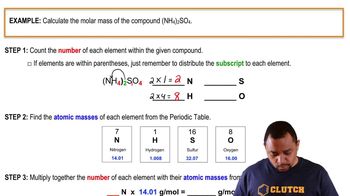
Molar mass is defined as the mass of one mole of a substance, typically expressed in grams per mole (g/mol). To find the molar mass of adrenaline in this scenario, we can rearrange the boiling point elevation formula to solve for the molar mass using the mass of adrenaline and the calculated molality from the boiling point change. This process involves understanding the relationship between mass, moles, and the properties of the solution.
추천 영상:
가이드 코스
03:12
Molar Mass Calculation Example