Ch.13 - Properties of Solutions
Brown - Chemistry: The Central Science 14th Edition
Brown14th EditionChemistry: The Central ScienceISBN: 9780134414232당신이 사용하는 게 아니라요?교과서 변경
13장, 문제 17b

An ionic compound has a very negative ∆Hsoln in water (b) Which term would you expect to be the largest negative number: ∆Hsolvent, ∆Hsolute, or ∆Hmix?

검증된 단계별 안내
1
Understand that the enthalpy of solution (∆H_{soln}) is the sum of three components: ∆H_{solute}, ∆H_{solvent}, and ∆H_{mix}.
Recognize that a very negative ∆H_{soln} indicates that the overall process of dissolving the ionic compound in water is highly exothermic.
Recall that ∆H_{solute} is the energy required to break the ionic bonds in the solute, which is typically positive.
Recall that ∆H_{solvent} is the energy required to disrupt the intermolecular forces in the solvent, which is also typically positive.
Conclude that ∆H_{mix}, which is the energy released when new interactions form between the solute and solvent, must be the largest negative number to result in a very negative ∆H_{soln}.

비슷한 문제에 대한 검증된 영상 답변:

이 영상 해법은 위 문제에 도움이 된다고 튜터들이 추천한 것입니다.
영상 길이:
1m
도움이 되었나요?

주요 개념

질문에 올바르게 답하기 위해 반드시 이해해야 하는 핵심 개념들은 다음과 같습니다.

Enthalpy of Solution (∆H<sub>soln</sub>)

The enthalpy of solution (∆H<sub>soln</sub>) refers to the heat change that occurs when a solute dissolves in a solvent. A very negative ∆H<sub>soln</sub> indicates that the dissolution process is exothermic, meaning it releases heat. This is often the case for ionic compounds, where the energy released from solute-solvent interactions exceeds the energy required to separate the solute particles.
추천 영상:
가이드 코스
02:34
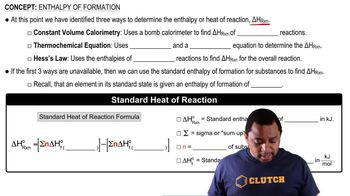
Enthalpy of Formation

Enthalpy Changes in Solution Process

The dissolution of a solute in a solvent involves three key enthalpy changes: ∆H<sub>solute</sub> (energy required to separate solute particles), ∆H<sub>solvent</sub> (energy required to separate solvent molecules), and ∆H<sub>mix</sub> (energy released when solute and solvent interact). Understanding these components helps in predicting the overall enthalpy change during the dissolution process and determining which term will be the largest negative value.
추천 영상:
가이드 코스
02:34
Enthalpy of Formation

Comparison of Enthalpy Terms

In the context of an ionic compound dissolving in water, the term ∆H<sub>mix</sub> is typically the largest negative number because it represents the strong interactions formed between the ions and water molecules. This strong solvation energy often outweighs the energy required to separate both the solute and solvent, leading to a significant release of energy during the mixing process.
추천 영상:
가이드 코스
02:34
Enthalpy of Formation