Ch.13 - Properties of Solutions
Brown - Chemistry: The Central Science 14th Edition
Brown14th EditionChemistry: The Central ScienceISBN: 9780134414232당신이 사용하는 게 아니라요?교과서 변경
13장, 문제 84

Based on the data given in Table 13.4, which solution would give the larger freezing-point lowering, a 0.030 m solution of NaCl or a 0.020 m solution of K2SO4?

검증된 단계별 안내
1
Step 1: Understand the concept of freezing-point depression, which is a colligative property. It depends on the number of solute particles in a solution, not their identity.
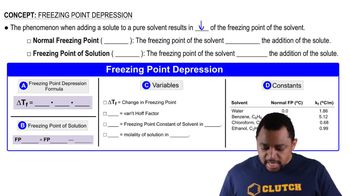
Step 2: Use the formula for freezing-point depression: \( \Delta T_f = i \cdot K_f \cdot m \), where \( \Delta T_f \) is the freezing-point depression, \( i \) is the van't Hoff factor, \( K_f \) is the freezing-point depression constant, and \( m \) is the molality of the solution.
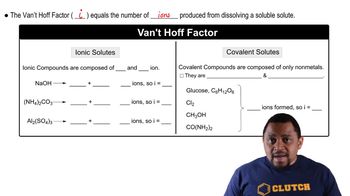
Step 3: Determine the van't Hoff factor \( i \) for each solute. For NaCl, which dissociates into Na\(^+\) and Cl\(^-\), \( i = 2 \). For K\(_2\)SO\(_4\), which dissociates into 2 K\(^+\) and SO\(_4\)\(^{2-}\), \( i = 3 \).
Step 4: Calculate the effective molality for each solution by multiplying the molality by the van't Hoff factor: \( 0.030 \text{ m} \times 2 \) for NaCl and \( 0.020 \text{ m} \times 3 \) for K\(_2\)SO\(_4\).
Step 5: Compare the effective molalities to determine which solution has a larger freezing-point lowering. The solution with the higher effective molality will have a greater freezing-point depression.

주요 개념

질문에 올바르게 답하기 위해 반드시 이해해야 하는 핵심 개념들은 다음과 같습니다.

Freezing Point Depression

Freezing point depression is a colligative property that describes how the freezing point of a solvent decreases when a solute is added. The extent of this depression depends on the number of solute particles in solution rather than their identity. The formula for calculating freezing point depression is ΔTf = i * Kf * m, where 'i' is the van 't Hoff factor, 'Kf' is the freezing point depression constant, and 'm' is the molality of the solution.
추천 영상:
가이드 코스
01:59
Freezing Point Depression

Van 't Hoff Factor (i)

The van 't Hoff factor (i) indicates the number of particles into which a solute dissociates in solution. For example, NaCl dissociates into two ions (Na+ and Cl-), so i = 2, while K2SO4 dissociates into three ions (2 K+ and SO4^2-), giving i = 3. This factor is crucial for calculating colligative properties, as it directly affects the total number of solute particles in the solution.
추천 영상:
가이드 코스
02:50
Van't Hoff Factor

Molality (m)

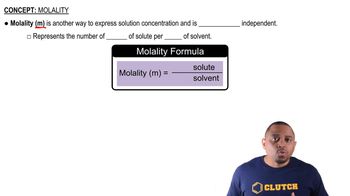
Molality (m) is a measure of the concentration of a solute in a solution, defined as the number of moles of solute per kilogram of solvent. It is particularly useful in colligative property calculations because it remains unaffected by temperature changes, unlike molarity. In this question, the molalities of the NaCl and K2SO4 solutions are essential for determining their respective freezing point depressions.
추천 영상: