By referring to Figure 13.15, determine whether the addition of 40.0 g of each of the following ionic solids to 100 g of water at 40 °C will lead to a saturated solution: (d) Pb(NO3)2.
Ch.13 - Properties of Solutions
13장, 문제 26b
By referring to Figure 13.15, determine the mass of each of the following salts required to form a saturated solution in 250 g of water at 30 °C: (b) Pb(NO3)2,
검증된 단계별 안내1
Identify the solubility of Pb(NO_3)_2 at 30 °C from Figure 13.15. This value is typically given in grams of solute per 100 grams of water.
Since the solubility is given per 100 grams of water, calculate the amount of Pb(NO_3)_2 needed for 250 grams of water. Use the ratio: (solubility in g/100 g water) = (x g/250 g water).
Solve the proportion to find the mass of Pb(NO_3)_2 required for 250 grams of water.
Ensure the units are consistent throughout the calculation to avoid any errors.
Double-check the solubility value from the figure to ensure accuracy in your calculations.

비슷한 문제에 대한 검증된 영상 답변:
이 영상 해법은 위 문제에 도움이 된다고 튜터들이 추천한 것입니다.
영상 길이:
2m주요 개념
질문에 올바르게 답하기 위해 반드시 이해해야 하는 핵심 개념들은 다음과 같습니다.
Saturation and Solubility
Saturation refers to the point at which a solution can no longer dissolve additional solute at a given temperature and pressure. Solubility is the maximum amount of solute that can dissolve in a specific amount of solvent at a particular temperature. Understanding these concepts is crucial for determining how much of a salt, like Pb(NO3)2, can be dissolved in water.
추천 영상:
가이드 코스
Solubility Rules
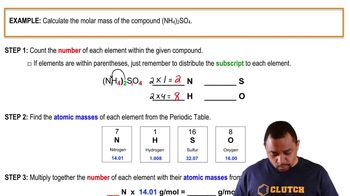
Molar Mass Calculation
Molar mass is the mass of one mole of a substance, typically expressed in grams per mole (g/mol). To find the mass of Pb(NO3)2 needed for a saturated solution, one must first calculate its molar mass by summing the atomic masses of its constituent elements. This calculation is essential for converting between moles and grams in stoichiometric problems.
추천 영상:
가이드 코스
Molar Mass Calculation Example
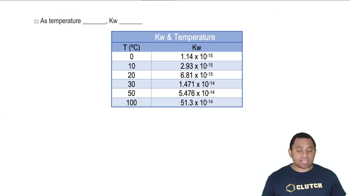
Temperature Dependence of Solubility
The solubility of most salts varies with temperature; generally, solubility increases with rising temperature. For the question at hand, knowing that the solubility of Pb(NO3)2 at 30 °C is necessary to determine how much of the salt can be dissolved in 250 g of water. This relationship is key to solving the problem accurately.
추천 영상:
가이드 코스
Kw Temperature Dependence
관련 실천
교과서 질문
875
views
교과서 질문
By referring to Figure 13.15, determine the mass of each of the following salts required to form a saturated solution in 250 g of water at 30 °C: (c) Ce2(SO4)3.
967
views
2
rank
교과서 질문
By referring to Figure 13.15, determine whether the addition of 40.0 g of each of the following ionic solids to 100 g of water at 40 °C will lead to a saturated solution:(c) K2Cr2O7
404
views
교과서 질문
Oil and water are immiscible. Which is the most likely reason? (a) Oil molecules are denser than water. (b) Oil molecules are composed mostly of carbon and hydrogen. (c) Oil molecules have higher molar masses than water. (d) Oil molecules have higher vapor pressures than water. (e) Oil molecules have higher boiling points than water.
1609
views