
Using data from Table 13.3, calculate the freezing and boiling points of each of the following solutions: (a) 0.22 m glycerol (C3H8O3) in ethanol, (b) 0.240 mol of naphthalene (C10H8) in 2.45 mol of chloroform, (c) 1.50 g NaCl in 0.250 kg of water, (d) 2.04 g KBr and 4.82 g of glucose (C6H12O6) in 188 g of water.
Ch.13 - Properties of Solutions
13장, 문제 75
How many grams of ethylene glycol (C2H6O2) must be added to 1.00 kg of water to produce a solution that freezes at -5.00 °C?
검증된 단계별 안내1
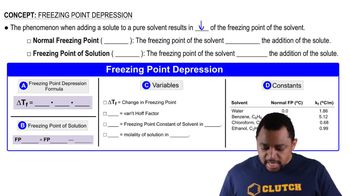
Step 1: Identify the freezing point depression formula: \( \Delta T_f = i \cdot K_f \cdot m \), where \( \Delta T_f \) is the change in freezing point, \( i \) is the van't Hoff factor, \( K_f \) is the freezing point depression constant for water, and \( m \) is the molality of the solution.
Step 2: Calculate \( \Delta T_f \) by subtracting the freezing point of the solution (-5.00 °C) from the normal freezing point of water (0.00 °C).
Step 3: Use the van't Hoff factor \( i = 1 \) for ethylene glycol, as it does not dissociate in solution, and find the value of \( K_f \) for water, which is typically 1.86 °C kg/mol.
Step 4: Rearrange the freezing point depression formula to solve for molality \( m \): \( m = \frac{\Delta T_f}{i \cdot K_f} \).
Step 5: Calculate the mass of ethylene glycol needed using the formula \( m = \frac{\text{moles of solute}}{\text{kg of solvent}} \), and convert moles to grams using the molar mass of ethylene glycol (C2H6O2), which is approximately 62.07 g/mol.
주요 개념
질문에 올바르게 답하기 위해 반드시 이해해야 하는 핵심 개념들은 다음과 같습니다.
Freezing Point Depression
Freezing point depression is a colligative property that describes how the addition of a solute to a solvent lowers the freezing point of the solvent. The extent of this depression depends on the number of solute particles in the solution, not their identity. The formula used to calculate the change in freezing point is ΔTf = i * Kf * m, where i is the van 't Hoff factor, Kf is the freezing point depression constant of the solvent, and m is the molality of the solution.
추천 영상:
가이드 코스
Freezing Point Depression
Molality
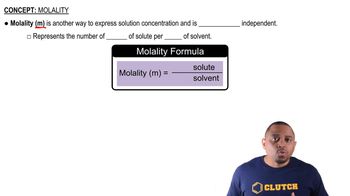
Molality (m) is a measure of concentration defined as the number of moles of solute per kilogram of solvent. It is particularly useful in colligative property calculations because it directly relates to the number of solute particles in a given mass of solvent. To find molality, you can use the formula m = moles of solute / mass of solvent (in kg), which helps in determining how much solute is needed to achieve a desired freezing point.
추천 영상:
가이드 코스
Molality
Ethylene Glycol Properties
Ethylene glycol (C2H6O2) is a common antifreeze agent that, when dissolved in water, significantly lowers the freezing point of the solution. Understanding its molecular weight (62.07 g/mol) is essential for converting between grams and moles, which is necessary for calculating how much ethylene glycol is needed to achieve the desired freezing point depression. Its van 't Hoff factor is 1, as it does not dissociate into ions in solution.
추천 영상:
가이드 코스
Physical Properties
관련 실천
교과서 질문
1130
views
교과서 질문
Seawater contains 34 g of salts for every liter of solution. Assuming that the solute consists entirely of NaCl (in fact, over 90% of the salt is indeed NaCl), calculate the osmotic pressure of seawater at 20 °C
833
views
교과서 질문
Using data from Table 13.3, calculate the freezing and boiling points of each of the following solutions: (a) 0.25 m glucose in ethanol; (b) 20.0 g of decane, C10H22, in 50.0 g CHCl3; (c) 3.50 g NaOH in 175 g of water, (d) 0.45 mol ethylene glycol and 0.15 mol KBr in 150 g H2O.
1576
views
교과서 질문
What is the freezing point of an aqueous solution that boils at 105.0 °C?
2072
views
2
rank
