Indicate the principal type of solute–solvent interaction in each of the following solutions and rank the solutions from weakest to strongest solute–solvent interaction: (b) CH2Cl2 in benzene (C6H6)
Ch.13 - Properties of Solutions
13장, 문제 16a
Indicate the principal type of solute–solvent interaction in each of the following solutions and rank the solutions from weakest to strongest solute–solvent interaction: (a) KCl in water
검증된 단계별 안내1
Identify the type of solute and solvent: KCl is an ionic compound, and water is a polar solvent.
Determine the principal type of interaction: In a solution of KCl in water, the principal interaction is ion-dipole interaction. This occurs because the positive and negative ions of KCl interact with the partial negative and positive charges of the water molecules, respectively.
Consider the strength of ion-dipole interactions: Ion-dipole interactions are generally strong because they involve the attraction between charged ions and polar molecules.
Compare with other types of interactions: Ion-dipole interactions are typically stronger than dipole-dipole interactions and hydrogen bonding, but weaker than covalent or ionic bonds.
Rank the interaction: Since the problem only provides one solution, KCl in water, it is ranked based on the strength of ion-dipole interactions, which are strong compared to other solute-solvent interactions.

비슷한 문제에 대한 검증된 영상 답변:
이 영상 해법은 위 문제에 도움이 된다고 튜터들이 추천한 것입니다.
영상 길이:
1m주요 개념
질문에 올바르게 답하기 위해 반드시 이해해야 하는 핵심 개념들은 다음과 같습니다.
Ion-Dipole Interactions
Ion-dipole interactions occur between an ion and a polar molecule, such as water. In the case of KCl dissolved in water, the potassium (K+) and chloride (Cl-) ions interact with the dipole of water molecules, leading to strong solvation. This type of interaction is crucial for understanding how ionic compounds dissolve in polar solvents.
추천 영상:
가이드 코스
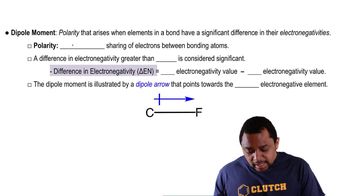
Dipole Moment
Solvation
Solvation is the process by which solvent molecules surround and interact with solute particles. In the context of KCl in water, solvation involves water molecules forming a hydration shell around the K+ and Cl- ions, stabilizing them in solution. This process is essential for the dissolution of ionic compounds and affects the overall solute-solvent interaction strength.
추천 영상:
가이드 코스
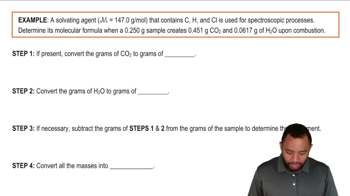
Molecular Formula via Combustion Example
Ranking Solute-Solvent Interactions
Ranking solute-solvent interactions involves comparing the strength of different types of interactions present in various solutions. In this case, KCl in water exhibits strong ion-dipole interactions, which are typically stronger than hydrogen bonding or van der Waals forces found in other solutions. Understanding this ranking helps predict the behavior of solutes in different solvents.
추천 영상:
가이드 코스
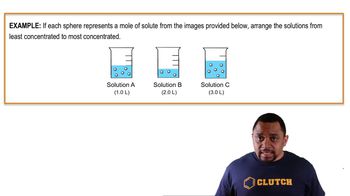
Ranking Solutions Example
관련 실천
교과서 질문
589
views
교과서 질문
Indicate the type of solute–solvent interaction (Section 11.2) that should be most important in each of the following solutions: (c) KBr in water
551
views
교과서 질문
Indicate the type of solute–solvent interaction (Section 11.2) that should be most important in each of the following solutions: (b) methanol (CH3OH) in water
966
views
교과서 질문
Indicate the principal type of solute–solvent interaction in each of the following solutions and rank the solutions from weakest to strongest solute–solvent interaction: (c) methanol (CH3OH) in water
549
views
교과서 질문
Indicate the type of solute–solvent interaction (Section 11.2) that should be most important in each of the following solutions: (d) HCl in acetonitrile (CH3CN)
759
views