
Ch.13 - Properties of Solutions
Brown - Chemistry: The Central Science 14th Edition
Brown14th EditionChemistry: The Central ScienceISBN: 9780134414232당신이 사용하는 게 아니라요?교과서 변경
13장, 문제 62b

You make a solution of a nonvolatile solute with a liquid solvent. Indicate if each of the following statements is true or false. (b) The solid that forms as the solution freezes is nearly pure solute.

검증된 단계별 안내
1
insert step 1> Identify the components of the solution: a nonvolatile solute and a liquid solvent.
insert step 2> Understand the process of freezing: as the solution cools, the solvent molecules begin to form a solid structure (crystal lattice).
insert step 3> Consider the nature of the solute: since it is nonvolatile, it does not easily escape into the vapor phase, but it can still be excluded from the solid structure formed by the solvent.
insert step 4> Recognize that during freezing, the solvent molecules preferentially form the solid phase, often excluding the solute molecules, leading to a solid that is nearly pure solvent.
insert step 5> Conclude that the statement is false because the solid that forms as the solution freezes is nearly pure solvent, not solute.

비슷한 문제에 대한 검증된 영상 답변:

이 영상 해법은 위 문제에 도움이 된다고 튜터들이 추천한 것입니다.
영상 길이:
1m
도움이 되었나요?

주요 개념

질문에 올바르게 답하기 위해 반드시 이해해야 하는 핵심 개념들은 다음과 같습니다.

Nonvolatile Solute

A nonvolatile solute is a substance that does not readily evaporate at room temperature and has a low vapor pressure compared to the solvent. When dissolved in a solvent, it affects the physical properties of the solution, such as lowering the freezing point. This property is crucial in understanding how solutes influence the freezing behavior of solutions.
추천 영상:
가이드 코스
01:39
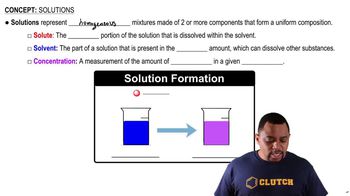
Solution Components

Freezing Point Depression

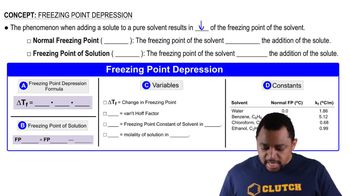
Freezing point depression is a colligative property that describes how the addition of a solute to a solvent lowers the temperature at which the solvent freezes. This phenomenon occurs because solute particles disrupt the formation of the solid lattice structure of the solvent, requiring a lower temperature to achieve solidification. Understanding this concept is essential for predicting the behavior of solutions upon freezing.
추천 영상:
가이드 코스
01:59
Freezing Point Depression

Purity of Crystallized Solute

When a solution freezes, the solid that forms is typically composed of the solvent in a crystalline structure, while the solute remains dissolved in the liquid phase. In the case of a nonvolatile solute, the solid that forms is not pure solute; instead, it is primarily the solvent, with the solute remaining in the unfrozen solution. This concept is important for understanding the composition of solids formed from solutions.
추천 영상:
가이드 코스
01:39
Solution Components