
Ch.14 - Chemical Kinetics
Brown - Chemistry: The Central Science 14th Edition
Brown14th EditionChemistry: The Central ScienceISBN: 9780134414232당신이 사용하는 게 아니라요?교과서 변경
14장, 문제 102

A colored dye compound decomposes to give a colorless product. The original dye absorbs at 608 nm and has an extinction coefficient of 4.7 * 10^4 M^-1 cm^-1 at that wavelength. You perform the decomposition reaction in a 1-cm cuvette in a spectrometer and obtain the following data: Time (min) Absorbance at 608 nm 0 1.254 30 0.941 60 0.752 90 0.672 120 0.545. From these data, determine the rate law for the reaction 'dye → product' and determine the rate constant.

검증된 단계별 안내
1
Step 1: Use the Beer-Lambert Law, A = εcl, to determine the concentration of the dye at each time point. Here, A is the absorbance, ε is the extinction coefficient (4.7 * 10^4 M^-1 cm^-1), c is the concentration, and l is the path length of the cuvette (1 cm). Rearrange the equation to solve for concentration: c = A / (εl).
Step 2: Calculate the concentration of the dye at each time point using the absorbance values provided. For example, at time 0 min, the concentration c = 1.254 / (4.7 * 10^4 * 1). Repeat this calculation for each time point.
Step 3: Plot the concentration of the dye versus time to visually inspect the data. This will help determine the order of the reaction. If the plot of concentration vs. time is linear, the reaction is zero-order. If the plot of ln(concentration) vs. time is linear, the reaction is first-order. If the plot of 1/concentration vs. time is linear, the reaction is second-order.
Step 4: Based on the plot that gives a straight line, determine the order of the reaction. Use the appropriate integrated rate law to calculate the rate constant (k). For a first-order reaction, use ln([A]_t/[A]_0) = -kt. For a second-order reaction, use 1/[A]_t - 1/[A]_0 = kt.
Step 5: Calculate the rate constant (k) using the slope of the linear plot from Step 3. The slope of the plot corresponds to -k for a first-order reaction or k for a second-order reaction. Ensure the units of k are consistent with the order of the reaction.

주요 개념

질문에 올바르게 답하기 위해 반드시 이해해야 하는 핵심 개념들은 다음과 같습니다.

Beer-Lambert Law

The Beer-Lambert Law relates the absorbance of light by a substance to its concentration and path length. It states that absorbance (A) is directly proportional to the concentration (c) of the absorbing species and the path length (l) of the light through the sample: A = εcl, where ε is the molar absorptivity. This law is fundamental for analyzing spectroscopic data, allowing us to determine concentration changes over time.
추천 영상:

Rate Law

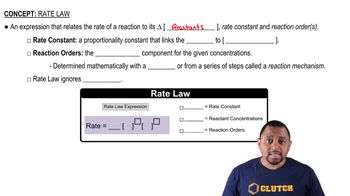
The rate law expresses the relationship between the rate of a chemical reaction and the concentration of its reactants. It is typically formulated as Rate = k[A]^m[B]^n, where k is the rate constant, and m and n are the orders of the reaction with respect to reactants A and B. Understanding the rate law is crucial for determining how the concentration of the dye changes over time and how it influences the reaction rate.
추천 영상:
가이드 코스
01:52
Rate Law Fundamentals

Order of Reaction

The order of a reaction indicates how the rate is affected by the concentration of reactants. It can be determined experimentally by analyzing how changes in concentration influence the rate of reaction. For example, a first-order reaction shows a linear relationship between the natural logarithm of concentration and time, while a second-order reaction shows a quadratic relationship. Identifying the order is essential for deriving the rate law and calculating the rate constant.
추천 영상:
가이드 코스
00:36
Average Bond Order