
교과서 질문
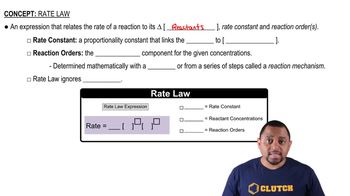
A reaction A + B → C obeys the following rate law: Rate = k[B]2. (a) If [A] is doubled, how will the rate change? Will the rate constant change?
1323
views
 검증된 단계별 안내

 02:03

 01:52
 01:14
A reaction A + B → C obeys the following rate law: Rate = k[B]2. (a) If [A] is doubled, how will the rate change? Will the rate constant change?
Consider a hypothetical reaction between A, B, and C that is first order in A, zero order in B, and second order in C. (b) How does the rate change when [A] is doubled and the other reactant concentrations are held constant? (c) How does the rate change when [B] is tripled and the other reactant concentrations are held constant? (d) How does the rate change when [C] is tripled and the other reactant concentrations are held constant? (f) By what factor does the rate change when the concentrations of all three reactants are cut in half?
Consider a hypothetical reaction between A, B, and C that is first order in A, zero order in B, and second order in C. (a) Write the rate law for the reaction.
A reaction A + B → C obeys the following rate law: Rate = k[B]2. (b) What are the reaction orders for A and B? What is the overall reaction order?
Consider a hypothetical reaction between A, B, and C that is first order in A, zero order in B, and second order in C. (e) By what factor does the rate change when the concentrations of all three reactants are tripled?