
Ch.14 - Chemical Kinetics
Brown - Chemistry: The Central Science 14th Edition
Brown14th EditionChemistry: The Central ScienceISBN: 9780134414232당신이 사용하는 게 아니라요?교과서 변경
14장, 문제 75a,b

(a) What is a catalyst? (b) What is the difference between a homogeneous and a heterogeneous catalyst?

검증된 단계별 안내
1
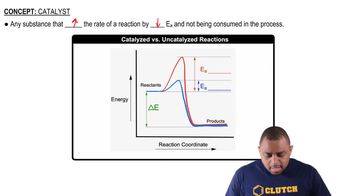
A catalyst is a substance that increases the rate of a chemical reaction without being consumed in the process. It works by providing an alternative reaction pathway with a lower activation energy.
Homogeneous catalysts are in the same phase as the reactants, typically in a solution. This allows them to interact more easily with the reactants, often forming intermediate compounds.
Heterogeneous catalysts are in a different phase than the reactants, usually solid catalysts in contact with gaseous or liquid reactants. The reaction occurs on the surface of the catalyst.
In homogeneous catalysis, the catalyst can be more easily mixed with the reactants, which can lead to a more uniform reaction environment. However, separation of the catalyst from the products can be challenging.
In heterogeneous catalysis, the catalyst can be easily separated from the reaction mixture, which is advantageous for industrial processes. However, the reaction is limited to the surface area of the catalyst.

비슷한 문제에 대한 검증된 영상 답변:

이 영상 해법은 위 문제에 도움이 된다고 튜터들이 추천한 것입니다.
영상 길이:
2m
도움이 되었나요?

주요 개념

질문에 올바르게 답하기 위해 반드시 이해해야 하는 핵심 개념들은 다음과 같습니다.

Catalyst

A catalyst is a substance that increases the rate of a chemical reaction without being consumed in the process. It works by providing an alternative reaction pathway with a lower activation energy, allowing reactants to convert to products more efficiently. Catalysts are crucial in both industrial processes and biological systems, where they facilitate reactions that would otherwise occur too slowly.
추천 영상:
가이드 코스
01:59
Catalyzed vs. Uncatalyzed Reactions

Homogeneous Catalyst

A homogeneous catalyst is one that exists in the same phase (solid, liquid, or gas) as the reactants in a chemical reaction. This uniformity allows for better interaction between the catalyst and the reactants, often leading to more efficient reactions. An example is the use of sulfuric acid in the esterification of alcohols, where both the catalyst and reactants are in the liquid phase.
추천 영상:
가이드 코스
01:59
Catalyzed vs. Uncatalyzed Reactions

Heterogeneous Catalyst

A heterogeneous catalyst is one that is in a different phase than the reactants, typically solid catalysts interacting with gaseous or liquid reactants. This phase difference can lead to distinct reaction mechanisms, often involving adsorption of reactants onto the catalyst surface. An example is the use of platinum in catalytic converters, where the solid metal facilitates the conversion of gaseous pollutants into less harmful substances.
추천 영상:
가이드 코스
01:59
Catalyzed vs. Uncatalyzed Reactions