
Ch.14 - Chemical Kinetics
Brown - Chemistry: The Central Science 14th Edition
Brown14th EditionChemistry: The Central ScienceISBN: 9780134414232당신이 사용하는 게 아니라요?교과서 변경
14장, 문제 37b

Consider the gas-phase reaction between nitric oxide and bromine at 273°C: 2 NO(g) + Br2(g) → 2 NOBr(g). The following data for the initial rate of appearance of NOBr were obtained:
Experiment [NO] (M) [Br2] (M) Initial Rate (M/s)
1 0.10 0.20 24
2 0.25 0.20 150
3 0.10 0.50 60
4 0.35 0.50 735 
(b) Calculate the average value of the rate constant for the appearance of NOBr from the four data sets.

검증된 단계별 안내
1
Write the rate law expression for the reaction based on the stoichiometry given in the balanced chemical equation. For the reaction 2 NO(g) + Br2(g) → 2 NOBr(g), the rate law can be expressed as Rate = k[NO]^m[Br2]^n, where k is the rate constant, and m and n are the orders of the reaction with respect to NO and Br2, respectively.
Use the given data from each experiment to set up an equation based on the rate law. For example, from Experiment 1, substitute the concentrations of NO and Br2 and the initial rate into the rate law equation: Rate = k[0.10]^m[0.20]^n = 24 M/s.
Solve the system of equations obtained from the data for each experiment to find the values of m and n. This typically involves taking logarithms of both sides of each equation and using linear algebra techniques to solve for the reaction orders m and n.
Once m and n are known, substitute these values back into the rate equations for each experiment to solve for k. For instance, using the values of m and n, calculate k from the equation for Experiment 1: k = 24 / (0.10^m * 0.20^n).
Calculate the average value of the rate constant k by averaging the k values obtained from each experiment. This gives a representative value of k for the reaction under the given conditions.

비슷한 문제에 대한 검증된 영상 답변:

이 영상 해법은 위 문제에 도움이 된다고 튜터들이 추천한 것입니다.
영상 길이:
7m

주요 개념

질문에 올바르게 답하기 위해 반드시 이해해야 하는 핵심 개념들은 다음과 같습니다.

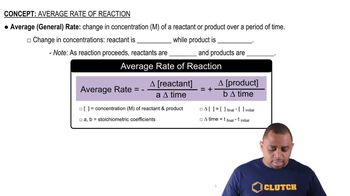
Rate of Reaction

The rate of reaction refers to the speed at which reactants are converted into products in a chemical reaction. It is typically expressed as the change in concentration of a reactant or product per unit time. Understanding how to interpret and calculate reaction rates is essential for analyzing experimental data and determining the kinetics of a reaction.
추천 영상:
가이드 코스
02:03
Average Rate of Reaction

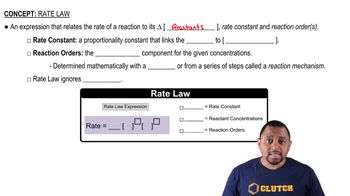
Rate Law

The rate law is an equation that relates the rate of a reaction to the concentration of its reactants, typically in the form Rate = k[A]^m[B]^n, where k is the rate constant, and m and n are the orders of the reaction with respect to each reactant. Determining the rate law from experimental data allows chemists to understand the relationship between concentration and reaction rate, which is crucial for calculating the rate constant.
추천 영상:
가이드 코스
01:52
Rate Law Fundamentals

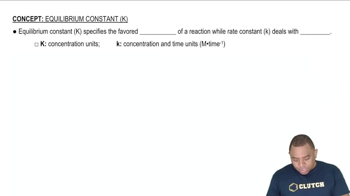
Rate Constant (k)

The rate constant (k) is a proportionality factor in the rate law that is specific to a given reaction at a specific temperature. It reflects the intrinsic speed of the reaction and is influenced by factors such as temperature and the presence of catalysts. Calculating the average value of the rate constant from multiple experiments provides insight into the overall kinetics of the reaction being studied.
추천 영상:
가이드 코스
01:14
Equilibrium Constant K