
Ch.14 - Chemical Kinetics
Brown - Chemistry: The Central Science 14th Edition
Brown14th EditionChemistry: The Central ScienceISBN: 9780134414232당신이 사용하는 게 아니라요?교과서 변경
14장, 문제 112e

In a hydrocarbon solution, the gold compound (CH3)3AuPH3 decomposes into ethane (C2H6) and a different gold compound, (CH3)AuPH3. The following mechanism has been proposed for the decomposition of (CH3)3AuPH3:
Step 1: (CH3)3AuPH3 k1⇌k-1 (CH3)3Au + PH3 (fast)
Step 2: (CH3)3Au k2→ C2H6 + (CH3)Au (slow)
Step 3: (CH3)Au + PH3 k3→ (CH3)AuPH3 (fast)
(e) What is the rate law predicted by this mechanism?

검증된 단계별 안내
1
Step 1: Identify the slow step in the reaction mechanism. In this case, it is Step 2: (CH3)3Au k2 C2H6 + (CH3)Au. The rate law of the reaction is determined by the slowest step, also known as the rate-determining step.
Step 2: Write the rate law for the slow step. The rate law is written as the rate equals the rate constant times the concentration of the reactants. In this case, the reactant is (CH3)3Au, so the rate law for this step is rate = k2[(CH3)3Au].
Step 3: Check if the reactants in the rate law are the products of the previous steps. If they are, we need to substitute them with the reactants of the previous steps. In this case, (CH3)3Au is the product of Step 1.
Step 4: Substitute the reactant in the rate law with the reactants of the previous step. The reactants of Step 1 are (CH3)3AuPH3. So, the rate law becomes rate = k2[(CH3)3AuPH3].
Step 5: This is the final rate law predicted by the mechanism. It shows that the rate of the reaction is directly proportional to the concentration of (CH3)3AuPH3.

비슷한 문제에 대한 검증된 영상 답변:

이 영상 해법은 위 문제에 도움이 된다고 튜터들이 추천한 것입니다.
영상 길이:
7m
도움이 되었나요?

주요 개념

질문에 올바르게 답하기 위해 반드시 이해해야 하는 핵심 개념들은 다음과 같습니다.

Reaction Mechanism

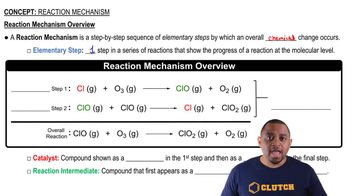
A reaction mechanism is a step-by-step description of the pathway through which reactants are converted into products. It outlines individual elementary steps, each with its own rate, and helps in understanding how the overall reaction occurs. In this case, the mechanism involves three steps, with the slowest step determining the rate of the overall reaction.
추천 영상:
가이드 코스
03:06
Reaction Mechanism Overview

Rate Law

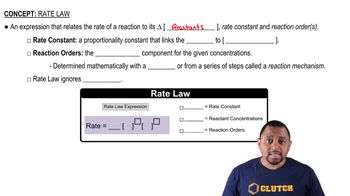
The rate law expresses the relationship between the rate of a chemical reaction and the concentration of its reactants. It is typically formulated based on the slowest step of the reaction mechanism, where the rate is proportional to the concentrations of the reactants raised to their respective powers. For the given mechanism, identifying the slow step is crucial to derive the correct rate law.
추천 영상:
가이드 코스
01:52
Rate Law Fundamentals

Elementary Steps

Elementary steps are individual reactions that occur in a reaction mechanism. Each step can be characterized by its own rate constant and molecularity, which indicates the number of molecules involved in the step. Understanding these steps is essential for determining the overall rate law, as the slowest elementary step dictates the rate of the entire reaction.
추천 영상:
가이드 코스
03:06
Reaction Mechanism Overview
관련 실천
교과서 질문

Platinum nanoparticles of diameter 2 nm are important catalysts in carbon monoxide oxidation to carbon dioxide. Platinum crystallizes in a face-centered cubic arrangement with an edge length of 3.924 Å. (c) Using your results from (a) and (b), calculate the percentage of Pt atoms that are on the surface of a 2.0-nm nanoparticle. (d) Repeat these calculations for a 5.0-nm platinum nanoparticle.

442
views
교과서 질문

In a hydrocarbon solution, the gold compound (CH3)3AuPH3 decomposes into ethane (C2H6) and a different gold compound, (CH3)AuPH3. The following mechanism has been proposed for the decomposition of (CH3)3AuPH3:

Step 1: (CH3)3AuPH3 k1⇌k-1 (CH3)3Au + PH3 (fast)

Step 2: (CH3)3Au k2→ C2H6 + (CH3)Au (slow)

Step 3: (CH3)Au + PH3 k3→ (CH3)AuPH3 (fast)

(c) What is the molecularity of each of the elementary steps?

358
views
교과서 질문

Platinum nanoparticles of diameter 2 nm are important catalysts in carbon monoxide oxidation to carbon dioxide. Platinum crystallizes in a face-centered cubic arrangement with an edge length of 3.924 Å. (b) Estimate how many platinum atoms are on the surface of a 2.0-nm Pt sphere, using the surface area of a sphere (4πr2) and assuming that the 'footprint' of one Pt atom can be estimated from its atomic diameter of 2.8 A .

462
views
교과서 질문

In a hydrocarbon solution, the gold compound (CH3)3AuPH3 decomposes into ethane (C2H6) and a different gold compound, (CH3)AuPH3. The following mechanism has been proposed for the decomposition of (CH3)3AuPH3:

Step 1: (CH3)3AuPH3 k1⇌k-1 (CH3)3Au + PH3 (fast)

Step 2: (CH3)3Au k2→ C2H6 + (CH3)Au (slow)

Step 3: (CH3)Au + PH3 k3→ (CH3)AuPH3 (fast)

(a) What is the overall reaction?

(b) What are the intermediates in the mechanism?

교과서 질문

In a hydrocarbon solution, the gold compound (CH3)3AuPH3 decomposes into ethane (C2H6) and a different gold compound, (CH3)AuPH3. The following mechanism has been proposed for the decomposition of (CH3)3AuPH3:

Step 1: (CH3)3AuPH3 k1⇌k-1 (CH3)3Au + PH3 (fast)

Step 2: (CH3)3Au k2→ C2H6 + (CH3)Au (slow)

Step 3: (CH3)Au + PH3 k3→ (CH3)AuPH3 (fast)

(f) What would be the effect on the reaction rate of adding PH3 to the solution of (CH3)3AuPH3?

422
views