Ch.14 - Chemical Kinetics
Brown - Chemistry: The Central Science 14th Edition
Brown14th EditionChemistry: The Central ScienceISBN: 9780134414232당신이 사용하는 게 아니라요?교과서 변경
14장, 문제 108b

Ozone in the upper atmosphere can be destroyed by the following two-step mechanism:
Cl(g) + O3(g) → ClO(g) + O2(g)
ClO(g) + O(g) → Cl(g) + O2(g) 
(b) What is the catalyst in the reaction?

검증된 단계별 안내
1
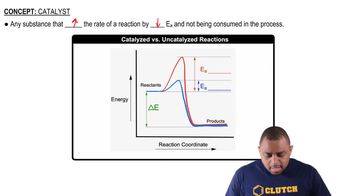
Identify the role of a catalyst in a chemical reaction. A catalyst is a substance that increases the rate of a reaction without being consumed in the process.
Examine the given reaction mechanism to identify any species that appear in the reactants of one step and are regenerated in the products of a subsequent step.
In the first step, Cl (chlorine) reacts with O3 (ozone) to form ClO and O2.
In the second step, ClO reacts with O to regenerate Cl and produce O2.
Notice that Cl is consumed in the first step and regenerated in the second step, indicating that Cl is the catalyst in this reaction mechanism.

비슷한 문제에 대한 검증된 영상 답변:

이 영상 해법은 위 문제에 도움이 된다고 튜터들이 추천한 것입니다.
영상 길이:
1m

주요 개념

질문에 올바르게 답하기 위해 반드시 이해해야 하는 핵심 개념들은 다음과 같습니다.

Catalysts

A catalyst is a substance that increases the rate of a chemical reaction without being consumed in the process. In the context of the ozone depletion mechanism, a catalyst facilitates the conversion of ozone (O3) into oxygen (O2) while remaining unchanged at the end of the reaction. This allows the catalyst to participate in multiple reaction cycles, making it effective even in small amounts.
추천 영상:
가이드 코스
01:59
Catalyzed vs. Uncatalyzed Reactions

Ozone Depletion

Ozone depletion refers to the reduction of ozone (O3) in the stratosphere, which is crucial for absorbing harmful ultraviolet (UV) radiation from the sun. The reaction mechanism provided illustrates how chlorine (Cl) compounds can catalyze the breakdown of ozone, leading to increased UV exposure on Earth's surface. Understanding this process is essential for grasping the environmental impact of certain pollutants.
추천 영상:
가이드 코스
00:46
Formation Equations Example 1

Reaction Mechanism

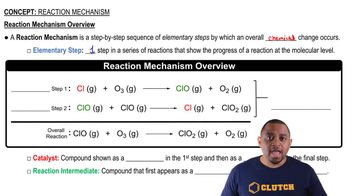
A reaction mechanism is a step-by-step description of how reactants are converted into products in a chemical reaction. It outlines the individual steps, intermediates, and transition states involved. In the given question, the two-step mechanism shows how chlorine reacts with ozone and how it regenerates, highlighting the role of intermediates like ClO in the overall process of ozone depletion.
추천 영상:
가이드 코스
03:06
Reaction Mechanism Overview
관련 실천
교과서 질문

Ozone in the upper atmosphere can be destroyed by the following two-step mechanism:

Cl(g) + O3(g) → ClO(g) + O2(g)

ClO(g) + O(g) → Cl(g) + O2(g)

(a) What is the overall equation for this process?

교과서 질문

The gas-phase decomposition of ozone is thought to occur by the following two-step mechanism.

Step 1: O3(g) ⇌ O2(g) + O(g) (fast)

Step 2: O(g) + O3(g) → 2 O2 (slow)

(b) Derive the rate law that is consistent with this mechanism. (Hint: The product appears in the rate law.)

867
views
교과서 질문

The following mechanism has been proposed for the reaction of NO with H2 to form N2O and H2O:

NO(g) + NO(g) → N2O2(g)

N2O2(g) + H2(g) → N2O(g) + H2O(g)

(d) The observed rate law is rate = k[NO]2[H2]. If the proposed mechanism is correct, what can we conclude about the relative speeds of the first and second reactions?

1616
views
교과서 질문

The following mechanism has been proposed for the reaction of NO with H2 to form N2O and H2O:

NO(g) + NO(g) → N2O2(g)

N2O2(g) + H2(g) → N2O(g) + H2O(g)

(a) Show that the elementary reactions of the proposed mechanism add to provide a balanced equation for the reaction.

교과서 질문

The gas-phase decomposition of ozone is thought to occur by the following two-step mechanism.

Step 1: O3(g) ⇌ O2(g) + O(g) (fast)

Step 2: O(g) + O3(g) → 2 O2 (slow)

(a) Write the balanced equation for the overall reaction.

교과서 질문

The gas-phase decomposition of ozone is thought to occur by the following two-step mechanism.

Step 1: O3(g) ⇌ O2(g) + O(g) (fast)

Step 2: O(g) + O3(g) → 2 O2 (slow)

(d) If instead the reaction occurred in a single step, would the rate law change? If so, what would it be?

1055
views