
Ch.14 - Chemical Kinetics
Brown - Chemistry: The Central Science 14th Edition
Brown14th EditionChemistry: The Central ScienceISBN: 9780134414232당신이 사용하는 게 아니라요?교과서 변경
14장, 문제 72b

The decomposition of hydrogen peroxide is catalyzed by iodide ion. The catalyzed reaction is thought to proceed by a two-step mechanism:
H2O2(aq) + I-(aq) → H2O(l) + IO-(aq) (slow)
IO-(aq) + H2O2(aq) → H2O(l) + O2(g) + I-(aq) (fast)
(b) Identify the intermediate, if any, in the mechanism.

검증된 단계별 안내
1
Step 1: Understand the concept of reaction intermediates. A reaction intermediate is a species that is produced in one step of a reaction mechanism and consumed in a subsequent step. It does not appear in the overall chemical equation for the reaction.
Step 2: Look at the given reaction mechanism. The first step produces H2O and IO-. The second step consumes IO- and produces H2O, O2, and I-.
Step 3: Identify the species that is produced in the first step and consumed in the second step. In this case, it is IO-.
Step 4: Confirm that this species does not appear in the overall chemical equation for the reaction. The overall equation is obtained by adding the two steps together and cancelling out any species that appear on both sides. In this case, IO- does not appear in the overall equation.
Step 5: Conclude that IO- is the reaction intermediate in this mechanism.

비슷한 문제에 대한 검증된 영상 답변:

이 영상 해법은 위 문제에 도움이 된다고 튜터들이 추천한 것입니다.
영상 길이:
2m

주요 개념

질문에 올바르게 답하기 위해 반드시 이해해야 하는 핵심 개념들은 다음과 같습니다.

Reaction Mechanism

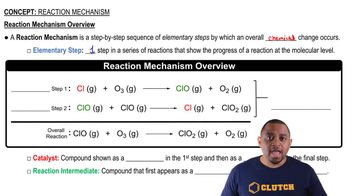
A reaction mechanism is a step-by-step description of how a chemical reaction occurs at the molecular level. It outlines the sequence of elementary steps that lead to the formation of products from reactants. Understanding the mechanism helps in identifying intermediates, which are species formed during the reaction but not present in the final products.
추천 영상:
가이드 코스
03:06
Reaction Mechanism Overview

Intermediates

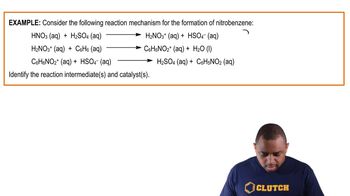
Intermediates are transient species that appear in the course of a reaction mechanism but do not appear in the overall balanced equation. They are formed in one step and consumed in a subsequent step. Identifying intermediates is crucial for understanding the pathway of the reaction and the role of catalysts.
추천 영상:
가이드 코스
02:14
Reaction Mechanism Example

Catalysis

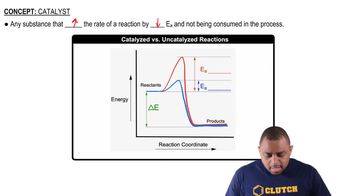
Catalysis is the process by which the rate of a chemical reaction is increased by the presence of a catalyst, which is not consumed in the reaction. Catalysts work by providing an alternative pathway with a lower activation energy. In the given reaction, iodide ion acts as a catalyst, facilitating the decomposition of hydrogen peroxide through the formation of intermediates.
추천 영상:
가이드 코스
01:59
Catalyzed vs. Uncatalyzed Reactions