
Ch.14 - Chemical Kinetics
Brown - Chemistry: The Central Science 14th Edition
Brown14th EditionChemistry: The Central ScienceISBN: 9780134414232당신이 사용하는 게 아니라요?교과서 변경
14장, 문제 72c

The decomposition of hydrogen peroxide is catalyzed by iodide ion. The catalyzed reaction is thought to proceed by a two-step mechanism:
H2O2(aq) + I-(aq) → H2O(l) + IO-(aq) (slow)
IO-(aq) + H2O2(aq) → H2O(l) + O2(g) + I-(aq) (fast)
(c) Assuming that the first step of the mechanism is rate determining, predict the rate law for the overall process.

검증된 단계별 안내
1
Identify the rate-determining step in the mechanism, which is the slow step: H_2O_2(aq) + I^-(aq) → H_2O(l) + IO^-(aq).
The rate law is determined by the rate-determining step, so write the rate law based on the reactants of this step.
Since the rate-determining step involves H_2O_2 and I^-, the rate law will be first order with respect to each of these reactants.
Express the rate law as: rate = k[H_2O_2][I^-], where k is the rate constant.
Note that the fast step does not affect the rate law, as it is not the rate-determining step.

비슷한 문제에 대한 검증된 영상 답변:

이 영상 해법은 위 문제에 도움이 된다고 튜터들이 추천한 것입니다.
영상 길이:
4m

주요 개념

질문에 올바르게 답하기 위해 반드시 이해해야 하는 핵심 개념들은 다음과 같습니다.

Rate Law

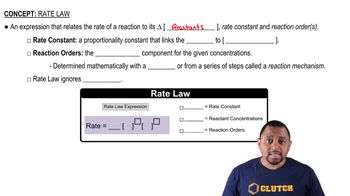
The rate law expresses the relationship between the rate of a chemical reaction and the concentration of its reactants. It is typically formulated as rate = k[A]^m[B]^n, where k is the rate constant, and m and n are the orders of the reaction with respect to reactants A and B. Understanding the rate law is crucial for predicting how changes in concentration affect the reaction rate.
추천 영상:
가이드 코스
01:52
Rate Law Fundamentals

Rate Determining Step

The rate determining step (RDS) is the slowest step in a reaction mechanism that dictates the overall reaction rate. In multi-step reactions, the RDS is critical because it limits how quickly the entire process can occur. Identifying the RDS allows chemists to simplify the analysis of complex reactions and focus on the most significant factors influencing the rate.
추천 영상:
가이드 코스
01:15
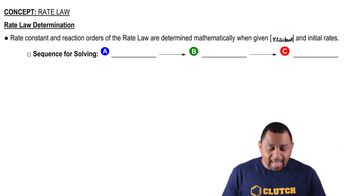
Rate Law Determination

Catalysis

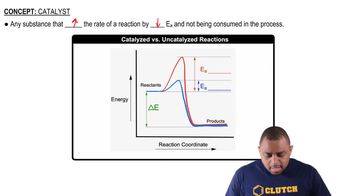
Catalysis involves the acceleration of a chemical reaction by a substance called a catalyst, which is not consumed in the reaction. In this case, iodide ion acts as a catalyst for the decomposition of hydrogen peroxide. Understanding how catalysts work and their effect on reaction mechanisms is essential for predicting reaction rates and designing efficient chemical processes.
추천 영상:
가이드 코스
01:59
Catalyzed vs. Uncatalyzed Reactions