
Ch.14 - Chemical Kinetics
Brown - Chemistry: The Central Science 14th Edition
Brown14th EditionChemistry: The Central ScienceISBN: 9780134414232당신이 사용하는 게 아니라요?교과서 변경
14장, 문제 21b

The isomerization of methyl isonitrile (CH3NC) to acetonitrile (CH3CN) was studied in the gas phase at 215°C, and the following data were obtained:
Time (s) [CH3NC] (M)
0 0.0165
2000 0.0110
5000 0.00591
8000 0.00314
12,000 0.00137
15,000 0.00074 
(b) Calculate the average rate of reaction over the entire time of the data from t = 0 to t = 15,000 s.
Table showing time in seconds and concentration of SCN- in M for chemical kinetics study.

검증된 단계별 안내
1
Step 1: Identify the initial concentration of CH3NC at t = 0 s, which is 0.0165 M.
Step 2: Identify the final concentration of CH3NC at t = 15,000 s, which is 0.00074 M.
Step 3: Calculate the change in concentration of CH3NC over the time period, Δ[CH3NC] = [CH3NC]final - [CH3NC]initial.
Step 4: Calculate the total time interval, Δt = 15,000 s - 0 s.
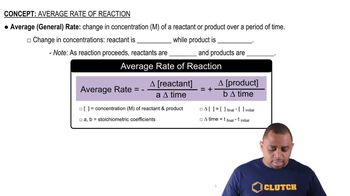
Step 5: Use the formula for the average rate of reaction: Average rate = -Δ[CH3NC] / Δt.

비슷한 문제에 대한 검증된 영상 답변:

이 영상 해법은 위 문제에 도움이 된다고 튜터들이 추천한 것입니다.
영상 길이:
1m

주요 개념

질문에 올바르게 답하기 위해 반드시 이해해야 하는 핵심 개념들은 다음과 같습니다.

Reaction Rate

The reaction rate is a measure of how quickly reactants are converted into products in a chemical reaction. It is typically expressed as the change in concentration of a reactant or product per unit time. In this case, the average rate can be calculated by determining the change in concentration of SCN- over the specified time interval.
추천 영상:
가이드 코스
02:03
Average Rate of Reaction

Concentration Change

Concentration change refers to the difference in the concentration of a substance at two different times during a reaction. For the isomerization of methyl isonitrile to acetonitrile, the concentration of SCN- decreases over time, which is essential for calculating the average rate of reaction. This change is crucial for understanding how the reaction progresses.
추천 영상:
가이드 코스
01:53
Chemical Changes

Average Rate Calculation

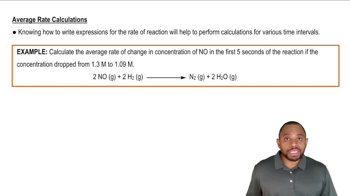
The average rate of a reaction can be calculated using the formula: Average Rate = (Change in Concentration) / (Change in Time). For this problem, you would subtract the final concentration of SCN- from the initial concentration and divide by the total time elapsed. This provides a straightforward way to quantify the overall speed of the reaction over the given time period.
추천 영상:
가이드 코스
02:42
Average Rate Calculation Example
관련 실천
교과서 질문

The rate of disappearance of HCl was measured for the following reaction: CH3OH1aq2 + HCl1aq2¡CH3Cl1aq2 + H2O1l2 The following data were collected: Time (min) 3HCl 4 1M2 0.0 1.85 54.0 1.58 107.0 1.36 215.0 1.02 430.0 0.580 (b) Calculate the average rate of reaction for the entire time for the data from t = 0.0 min to t = 430.0 min.

790
views
교과서 질문

The rate of disappearance of HCl was measured for the following reaction: CH3OH1aq2 + HCl1aq2¡CH3Cl1aq2 + H2O1l2 The following data were collected: Time (min) 3HCl 4 1M2 0.0 1.85 54.0 1.58 107.0 1.36 215.0 1.02 430.0 0.580 (a) Calculate the average rate of reaction, in M>s, for the time interval between each measurement.

555
views
교과서 질문

Consider the following hypothetical aqueous reaction: A(aq) → B(aq). A flask is charged with 0.065 mol of A in a total volume of 100.0 mL. The following data are collected: Time (min) 0 10 20 30 40 Moles of A 0.065 0.051 0.042 0.036 0.031 (c) Between t = 10 min and t = 30 min, what is the average rate of appearance of B in units of M/s? Assume that the volume of the solution is constant.

2
views
교과서 질문

The isomerization of methyl isonitrile (CH3NC) to acetonitrile (CH3CN) was studied in the gas phase at 215°C, and the following data were obtained:

Time (s) [CH3NC] (M)

0 0.0165

2000 0.0110

5000 0.00591

8000 0.00314

12,000 0.00137

15,000 0.00074 

(d) Graph [CH3NC] versus time and determine the instantaneous rates in M/s at t = 5000 s and t = 8000 s.

755
views
교과서 질문

The isomerization of methyl isonitrile (CH3NC) to acetonitrile (CH3CN) was studied in the gas phase at 215°C, and the following data were obtained:

Time (s) [CH3NC] (M)

0 0.0165

2000 0.0110

5000 0.00591

8000 0.00314

12,000 0.00137

15,000 0.00074

(a) Calculate the average rate of reaction, in M/s, for the time interval between each measurement. (c) Which is greater, the average rate between t = 2000 and t = 12,000 s, or between t = 8000 and t = 15,000 s?

2
views
교과서 질문

A flask is charged with 0.100 mol of A and allowed to react to form B according to the hypothetical gas-phase reaction A1g2¡B1g2. The following data are collected: Time (s) 0 40 80 120 160 Moles of A 0.100 0.067 0.045 0.030 0.020 (c) Which of the following would be needed to calculate the rate in units of concentration per time: (i) the pressure of the gas at each time, (ii) the volume of the reaction flask, (iii) the temperature, or (iv) the molecular weight of A?

1064
views