Ch.14 - Chemical Kinetics
Brown - Chemistry: The Central Science 14th Edition
Brown14th EditionChemistry: The Central ScienceISBN: 9780134414232당신이 사용하는 게 아니라요?교과서 변경
14장, 문제 122b

The rates of many atmospheric reactions are accelerated by the absorption of light by one of the reactants. For example, consider the reaction between methane and chlorine to produce methyl chloride and hydrogen chloride:
Reaction 1: CH4(g) + Cl2(g) → CH3Cl(g) + HCl(g)
This reaction is very slow in the absence of light. However, Cl2(g) can absorb light to form Cl atoms:
Reaction 2: Cl2(g) + hv → 2 Cl(g)
Once the Cl atoms are generated, they can catalyze the reaction of CH4 and Cl2, according to the following proposed mechanism:
Reaction 3: CH4(g) + Cl(g) → CH3(g) + HCl(g)
Reaction 4: CH3(g) + Cl2(g) → CH3Cl(g) + Cl(g)
The enthalpy changes and activation energies for these two reactions are tabulated as follows:
Reaction ΔH° (kJ/mol) Ea (kJ/mol)
3 +4 17
4 -109 4 
(b) By using the data tabulated here, sketch a quantitative energy profile for the catalyzed reaction represented by reactions 3 and 4.
Table showing enthalpy changes and activation energies for chemical reactions in Chapter 15.

검증된 단계별 안내
1
Identify the enthalpy changes (ΔH) and activation energies (Ea) for reactions 3 and 4 from the table provided.
For Reaction 3: Note that ΔH = +4 kJ/mol and Ea = 17 kJ/mol.
For Reaction 4: Note that ΔH = -109 kJ/mol and Ea = 4 kJ/mol.
Sketch the energy profile diagram: Start with the energy level of the reactants (CH4 and Cl2).
Draw the energy peaks for each reaction step, indicating the activation energies and the enthalpy changes, and finally show the energy level of the products (CH3Cl and HCl).

비슷한 문제에 대한 검증된 영상 답변:

이 영상 해법은 위 문제에 도움이 된다고 튜터들이 추천한 것입니다.
영상 길이:
3m

주요 개념

질문에 올바르게 답하기 위해 반드시 이해해야 하는 핵심 개념들은 다음과 같습니다.

Activation Energy (Ea)

Activation energy is the minimum energy required for a chemical reaction to occur. It represents the energy barrier that reactants must overcome to form products. In the context of the given reactions, lower activation energy indicates that the reaction can proceed more quickly, which is crucial for understanding how light absorption by Cl2 facilitates the reaction with methane.
추천 영상:
가이드 코스
02:02
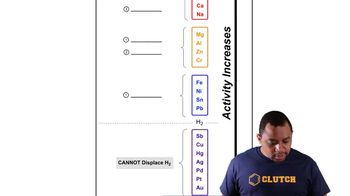
Activity Series Chart

Enthalpy Change (ΔH)

Enthalpy change refers to the heat content change during a chemical reaction at constant pressure. A negative ΔH indicates that the reaction is exothermic, releasing energy. In the provided reactions, the enthalpy changes help determine the overall energy profile and stability of the products compared to the reactants, which is essential for sketching the energy diagram.
추천 영상:
가이드 코스
02:34
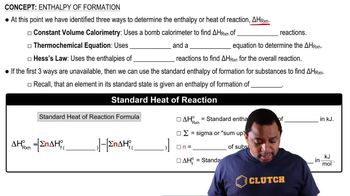
Enthalpy of Formation

Catalysis

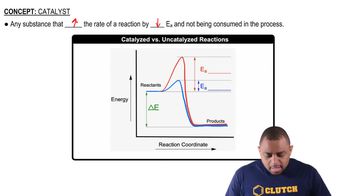
Catalysis is the process by which a substance (the catalyst) increases the rate of a chemical reaction without being consumed in the process. In this case, the Cl atoms generated from the light-absorbing Cl2 act as a catalyst, facilitating the reaction between methane and chlorine. Understanding catalysis is key to analyzing how the reaction mechanism is altered and how energy profiles are affected.
추천 영상:
가이드 코스
01:59
Catalyzed vs. Uncatalyzed Reactions