Ch.14 - Chemical Kinetics
Brown - Chemistry: The Central Science 14th Edition
Brown14th EditionChemistry: The Central ScienceISBN: 9780134414232당신이 사용하는 게 아니라요?교과서 변경
14장, 문제 32a

The reaction between ethyl bromide (C2H5Br) and hydroxide ion in ethyl alcohol at 330 K, C2H5Br(alc) + OH-(alc) → C2H5OH(l) + Br-(alc), is first order each in ethyl bromide and hydroxide ion. When [C2H5Br] is 0.0477 M and [OH-] is 0.100 M, the rate of disappearance of ethyl bromide is 1.7×10⁻⁷ M/s. (a) What is the value of the rate constant?

검증된 단계별 안내
1
Identify the rate law expression based on the given reaction order. Since the reaction is first order in both ethyl bromide and hydroxide ion, the rate law can be expressed as: Rate = k [C2H5Br][OH-].
Substitute the given concentrations and the rate of disappearance into the rate law expression. Here, [C2H5Br] = 0.0477 M, [OH-] = 0.100 M, and Rate = 1.7 * 10^-7 M/s.
Rearrange the rate law equation to solve for the rate constant k. This can be done by dividing both sides of the equation by the product of the concentrations of the reactants: k = Rate / ([C2H5Br][OH-]).
Plug the values into the rearranged equation to find the value of k. Ensure that all units are consistent for concentration (M) and time (s).
The calculated value of k will be in units of M^-1s^-1, which is appropriate given the reaction order and the units of the rate and concentrations.

비슷한 문제에 대한 검증된 영상 답변:

이 영상 해법은 위 문제에 도움이 된다고 튜터들이 추천한 것입니다.
영상 길이:
2m
도움이 되었나요?

주요 개념

질문에 올바르게 답하기 위해 반드시 이해해야 하는 핵심 개념들은 다음과 같습니다.

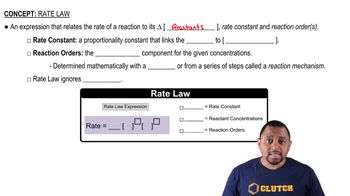
Rate Law

The rate law expresses the relationship between the rate of a chemical reaction and the concentration of its reactants. For a reaction that is first order in each reactant, the rate can be described by the equation: Rate = k[C2H5Br][OH-], where k is the rate constant. Understanding the rate law is essential for determining how changes in concentration affect the reaction rate.
추천 영상:
가이드 코스
01:52
Rate Law Fundamentals

First-Order Reactions

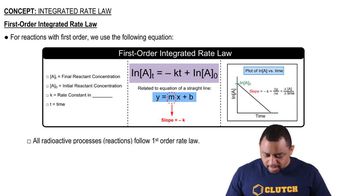
A first-order reaction is one where the rate is directly proportional to the concentration of one reactant. In this case, both ethyl bromide and hydroxide ion are first-order, meaning that doubling their concentrations will double the reaction rate. This concept is crucial for calculating the rate constant from the given rate and concentrations.
추천 영상:
가이드 코스
02:29
First-Order Reactions

Rate Constant (k)

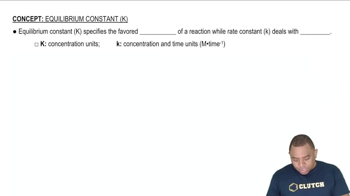
The rate constant (k) is a proportionality factor in the rate law that is specific to a given reaction at a specific temperature. It provides insight into the speed of the reaction; a larger k indicates a faster reaction. To find k, one can rearrange the rate law equation using the provided rate and concentrations, which is key to solving the problem.
추천 영상:
가이드 코스
01:14
Equilibrium Constant K
관련 실천
교과서 질문

Consider the following reaction: 2 NO1g2 + 2 H21g2¡N21g2 + 2 H2O1g2 (d) What is the reaction rate at 1000 K if [NO] is decreased to 0.010 M and 3H24 is increased to 0.030 M?

437
views

교과서 질문

The reaction between ethyl bromide (C2H5Br) and hydroxide ion in ethyl alcohol at 330 K, C2H5Br(alc) + OH-(alc) → C2H5OH(l) + Br-(alc), is first order each in ethyl bromide and hydroxide ion. When [C2H5Br] is 0.0477 M and [OH-] is 0.100 M, the rate of disappearance of ethyl bromide is 1.7×10⁻⁷ M/s. (b) What are the units of the rate constant?

교과서 질문

The iodide ion reacts with hypochlorite ion (the active ingredient in chlorine bleaches) in the following way: OCl- + I- → OI- + Cl- . This rapid reaction gives the following rate data:

[OCl4-] (M) [I-] (M) Initial Rate (M,s)

1.5 * 10-3 1.5 * 10-3

1.36 * 10-4 3.0 * 10-3 1.5 * 10-3 2.72 * 10-4

1.5 * 10-3 3.0 * 10-3 2.72 * 10-4

(a) Write the rate law for this reaction.

1867
views
교과서 질문

The reaction between ethyl bromide (C2H5Br) and hydroxide ion in ethyl alcohol at 330 K, C2H5Br(alc) + OH-(alc) → C2H5OH(l) + Br-(alc), is first order each in ethyl bromide and hydroxide ion. When [C2H5Br] is 0.0477 M and [OH-] is 0.100 M, the rate of disappearance of ethyl bromide is 1.7×10⁻⁷ M/s. (c) How would the rate of disappearance of ethyl bromide change if the solution were diluted by adding an equal volume of pure ethyl alcohol to the solution?

560
views
1
rank
교과서 질문

Consider the following reaction:

2 NO(g) + 2 H2(g) → N2(g) + 2 H2O(g)

(b) If the rate constant for this reaction at 1000 K is 6.0 × 10⁴ M-2 s-1, what is the reaction rate when [NO] = 0.035 M and [H2] = 0.015 M?

(c) What is the reaction rate at 1000 K when the concentration of NO is increased to 0.10 M, while the concentration of H2 is 0.010 M?