Ch.15 - Chemical Equilibrium
Brown - Chemistry: The Central Science 14th Edition
Brown14th EditionChemistry: The Central ScienceISBN: 9780134414232당신이 사용하는 게 아니라요?교과서 변경
15장, 문제 94

At a temperature of 700 K, the forward and reverse rate constants for the reaction 2 HI(g) ⇌ H2(g) + I2(g) are kf = 1.8×10⁻³⁰ M−1s−1 and kr = 0.063 M−1s−1.
(a) What is the value of the equilibrium constant Kc at 700 K?
(b) Is the forward reaction endothermic or exothermic if the rate constants for the same reaction have values of kf = 0.097M−1s−1 and kr = 2.6 M−1s−1 at 800 K?

검증된 단계별 안내
1
First, recall that the equilibrium constant (K) for a reaction is given by the ratio of the forward rate constant (kf) to the reverse rate constant (kr). So, K = kf/kr.
Calculate the equilibrium constant at 700 K using the given rate constants. K1 = kf1/kr1.
Next, calculate the equilibrium constant at 800 K using the given rate constants. K2 = kf2/kr2.
Compare the two equilibrium constants. If K2 > K1, the reaction shifts to the right (towards the products) as the temperature increases, indicating that the reaction is endothermic. If K2 < K1, the reaction shifts to the left (towards the reactants) as the temperature increases, indicating that the reaction is exothermic.
Remember, an endothermic reaction absorbs heat from its surroundings (ΔH > 0), while an exothermic reaction releases heat to its surroundings (ΔH < 0).

비슷한 문제에 대한 검증된 영상 답변:

이 영상 해법은 위 문제에 도움이 된다고 튜터들이 추천한 것입니다.
영상 길이:
4m
도움이 되었나요?

주요 개념

질문에 올바르게 답하기 위해 반드시 이해해야 하는 핵심 개념들은 다음과 같습니다.

Rate Constants and Temperature

Rate constants (k) are values that indicate the speed of a reaction at a given temperature. They are influenced by temperature changes, typically increasing with higher temperatures due to increased molecular energy and collision frequency. Understanding how rate constants vary with temperature is crucial for analyzing reaction kinetics and determining the nature of the reaction.
추천 영상:
가이드 코스
00:45
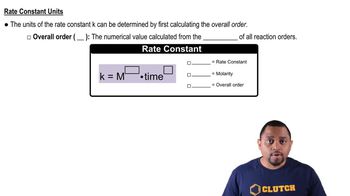
Rate Constant Units

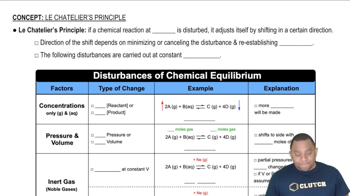
Equilibrium and Le Chatelier's Principle

Chemical equilibrium occurs when the rates of the forward and reverse reactions are equal, resulting in constant concentrations of reactants and products. Le Chatelier's Principle states that if a system at equilibrium is disturbed, it will shift in a direction that counteracts the disturbance. This principle helps predict how changes in temperature or concentration affect the position of equilibrium.
추천 영상:
가이드 코스
07:32
Le Chatelier's Principle

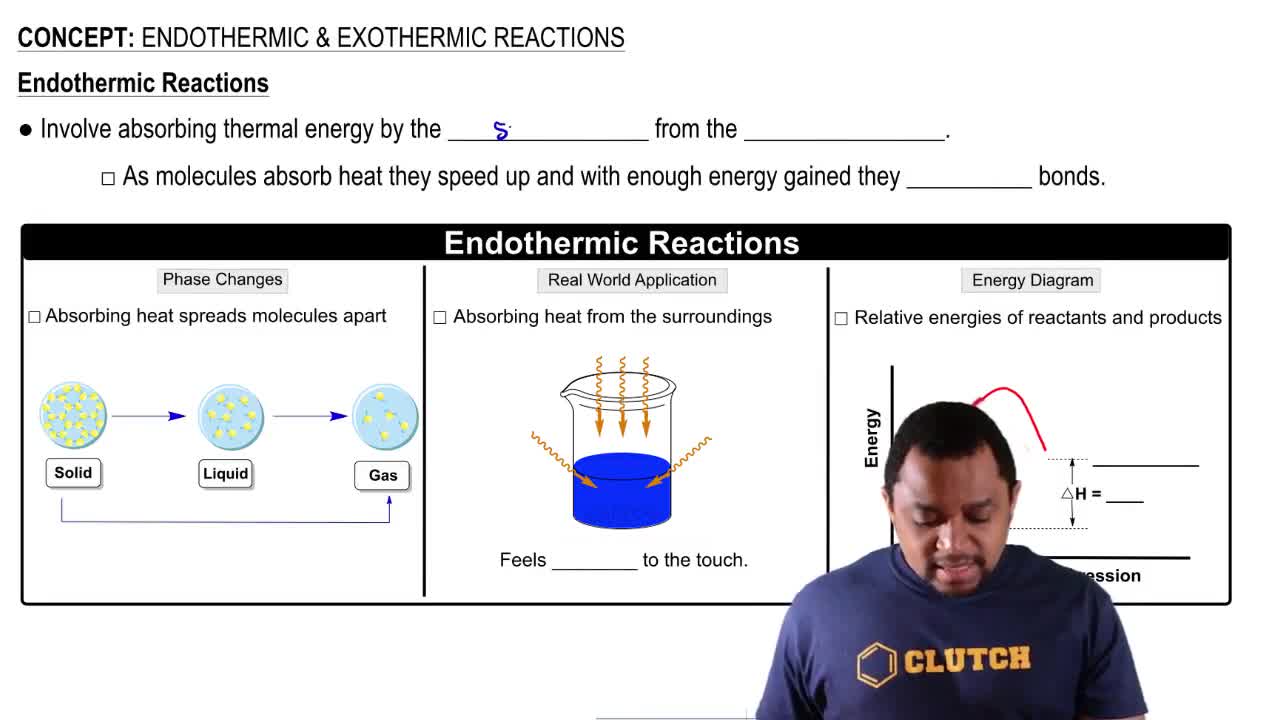
Endothermic vs. Exothermic Reactions

Endothermic reactions absorb heat from their surroundings, leading to a decrease in temperature, while exothermic reactions release heat, increasing the temperature. The nature of a reaction can be inferred from the temperature dependence of the rate constants; if increasing temperature increases the rate of the endothermic forward reaction more than the reverse, it suggests the forward reaction is endothermic.
추천 영상:
가이드 코스
02:30
Endothermic & Exothermic Reactions