
Ch.15 - Chemical Equilibrium
Brown - Chemistry: The Central Science 14th Edition
Brown14th EditionChemistry: The Central ScienceISBN: 9780134414232당신이 사용하는 게 아니라요?교과서 변경
15장, 문제 77

Consider the hypothetical reaction A1g2 Δ 2 B1g2. A flask is charged with 0.75 atm of pure A, after which it is allowed to reach equilibrium at 0 _x001F_C. At equilibrium, the partial pressure of A is 0.36 atm. (a) What is the total pressure in the flask at equilibrium?

검증된 단계별 안내
1
Start by writing the balanced chemical equation for the reaction: \( A(g) \rightarrow 2B(g) \). This indicates that one mole of A produces two moles of B.
Determine the change in pressure for A. Initially, the pressure of A is 0.75 atm, and at equilibrium, it is 0.36 atm. The change in pressure for A is \( 0.75 - 0.36 = 0.39 \) atm.
Use the stoichiometry of the reaction to find the change in pressure for B. Since 1 mole of A produces 2 moles of B, the change in pressure for B is \( 2 \times 0.39 = 0.78 \) atm.
Calculate the equilibrium pressure of B. Since B is formed from A, its equilibrium pressure is simply the change in pressure, which is 0.78 atm.
Add the equilibrium pressures of A and B to find the total pressure in the flask at equilibrium: \( 0.36 \text{ atm (A)} + 0.78 \text{ atm (B)} = 1.14 \text{ atm} \).

주요 개념

질문에 올바르게 답하기 위해 반드시 이해해야 하는 핵심 개념들은 다음과 같습니다.

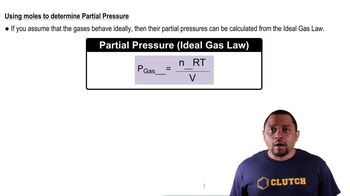
Partial Pressure

Partial pressure is the pressure exerted by a single component of a gas mixture. In a system at equilibrium, the total pressure is the sum of the partial pressures of all gases present. Understanding how to calculate partial pressures is essential for determining the total pressure in a reaction involving gases.
추천 영상:
가이드 코스
00:48
Partial Pressure Calculation

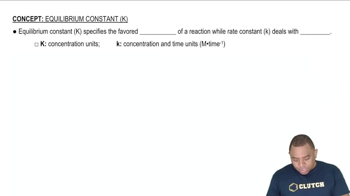
Equilibrium Constant

The equilibrium constant (K) is a value that expresses the ratio of the concentrations of products to reactants at equilibrium for a given reaction at a specific temperature. It helps predict the direction of the reaction and the concentrations of species at equilibrium. In this case, knowing the equilibrium constant can aid in understanding how the pressures of A and B relate to each other.
추천 영상:
가이드 코스
01:14
Equilibrium Constant K

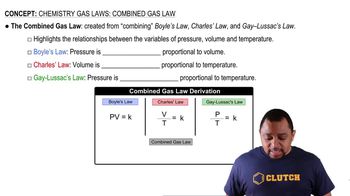
Gas Laws

Gas laws describe the behavior of gases in relation to pressure, volume, and temperature. The ideal gas law (PV=nRT) is particularly relevant here, as it relates the total pressure, volume, and temperature of a gas mixture. Understanding these laws is crucial for calculating the total pressure in the flask after the reaction reaches equilibrium.
추천 영상:
가이드 코스
01:43
Combined Gas Law