Ch.15 - Chemical Equilibrium
15์žฅ, ๋ฌธ์ œ 62d

Consider the reaction 4 NH3(๐‘”) + 5 O2(๐‘”) โ‡Œ 4 NO(๐‘”) + 6 H2O(๐‘”), ฮ”๐ป = โˆ’904.4 kJ Does each of the following increase, decrease, or leave unchanged the yield of NO at equilibrium? (d) decrease the volume of the container in which the reaction occurs

๊ฒ€์ฆ๋œ ๋‹จ๊ณ„๋ณ„ ์•ˆ๋‚ด
1
Identify the reaction type: The given reaction is an exothermic reaction, as indicated by the negative \( \Delta H \) value.
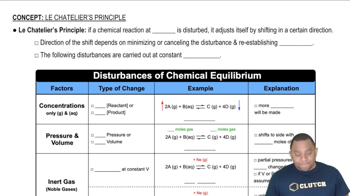
Apply Le Chatelier's Principle: This principle states that if a dynamic equilibrium is disturbed by changing the conditions, the position of equilibrium shifts to counteract the change.
Consider the effect of volume change: Decreasing the volume of the container increases the pressure of the system.
Analyze the reaction's response to pressure change: The reaction will shift towards the side with fewer moles of gas to reduce the pressure.
Count the moles of gas on each side: The left side has 9 moles (4 NH\(_3\) + 5 O\(_2\)), and the right side has 10 moles (4 NO + 6 H\(_2\)O). Therefore, decreasing the volume will shift the equilibrium towards the left, decreasing the yield of NO.

๋น„์Šทํ•œ ๋ฌธ์ œ์— ๋Œ€ํ•œ ๊ฒ€์ฆ๋œ ์˜์ƒ ๋‹ต๋ณ€:

์ด ์˜์ƒ ํ•ด๋ฒ•์€ ์œ„ ๋ฌธ์ œ์— ๋„์›€์ด ๋œ๋‹ค๊ณ  ํŠœํ„ฐ๋“ค์ด ์ถ”์ฒœํ•œ ๊ฒƒ์ž…๋‹ˆ๋‹ค.
์˜์ƒ ๊ธธ์ด:
2m

์ฃผ์š” ๊ฐœ๋…

์งˆ๋ฌธ์— ์˜ฌ๋ฐ”๋ฅด๊ฒŒ ๋‹ตํ•˜๊ธฐ ์œ„ํ•ด ๋ฐ˜๋“œ์‹œ ์ดํ•ดํ•ด์•ผ ํ•˜๋Š” ํ•ต์‹ฌ ๊ฐœ๋…๋“ค์€ ๋‹ค์Œ๊ณผ ๊ฐ™์Šต๋‹ˆ๋‹ค.

Le Chatelier's Principle

Le Chatelier's Principle states that if a dynamic equilibrium is disturbed by changing the conditions, the position of equilibrium shifts to counteract the change. In the context of gas reactions, reducing the volume of the container increases the pressure, prompting the equilibrium to shift toward the side with fewer moles of gas to alleviate the pressure increase.
์ถ”์ฒœ ์˜์ƒ:

Mole Ratio in Reactions

In chemical reactions, the mole ratio indicates the proportion of reactants and products involved. For the given reaction, there are 9 moles of gas on the reactant side (4 NHโ‚ƒ + 5 Oโ‚‚) and 10 moles on the product side (4 NO + 6 Hโ‚‚O). Understanding this ratio is crucial for predicting how changes in volume affect the equilibrium position.
์ถ”์ฒœ ์˜์ƒ:

Equilibrium Constant (K)

The equilibrium constant (K) quantifies the ratio of the concentrations of products to reactants at equilibrium. Changes in conditions, such as volume or temperature, can affect K. In this reaction, decreasing the volume increases the concentration of gases, which can shift the equilibrium position, thereby affecting the yield of NO.
์ถ”์ฒœ ์˜์ƒ:
๊ด€๋ จ ์‹ค์ฒœ